


 15 November, 2026
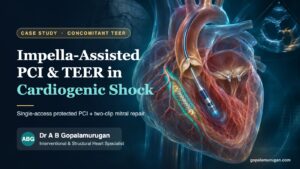
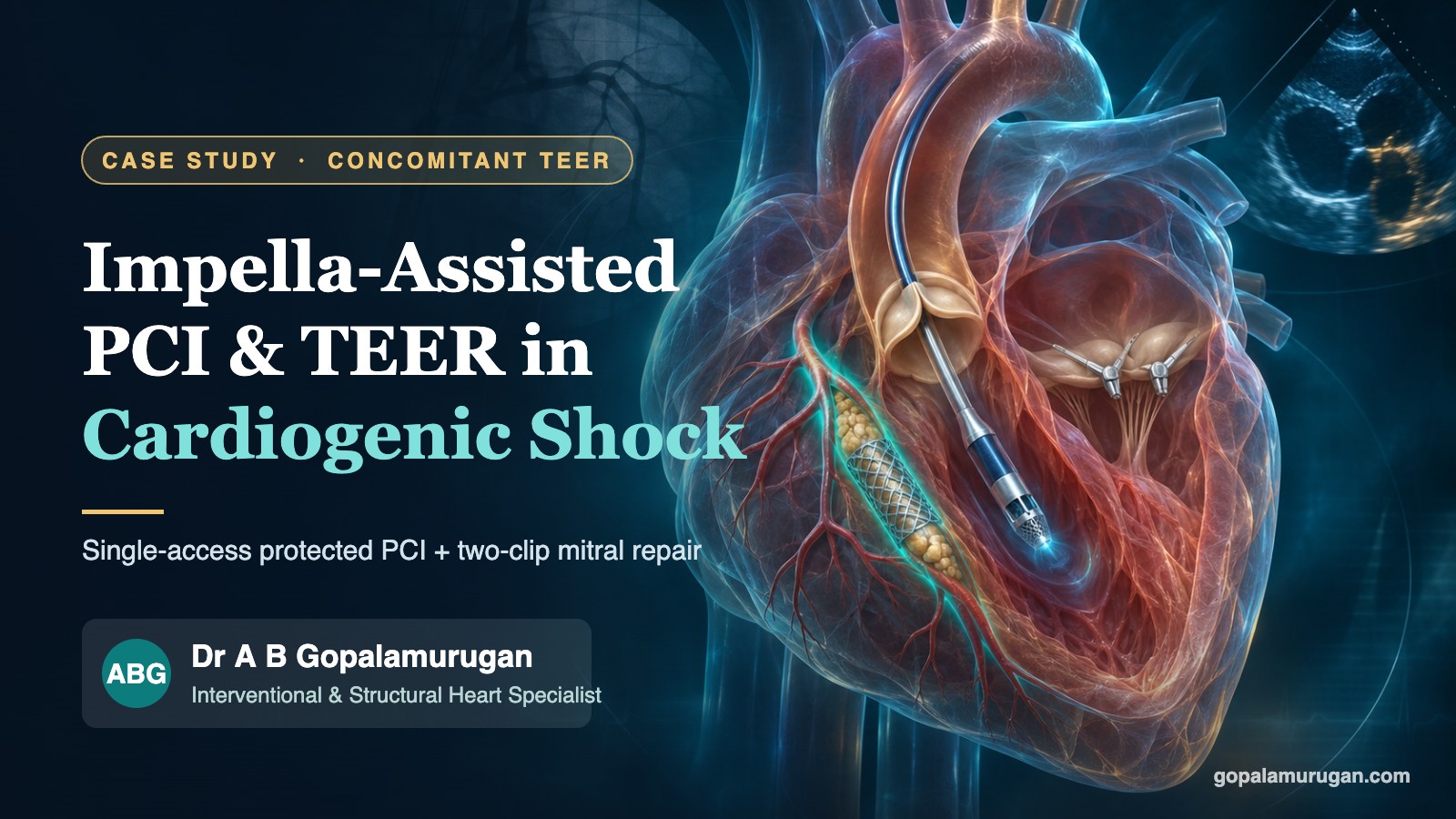
Impella-Assisted PCI and TEER in Cardiogenic Shock: A Case Study
A ventilated patient in cardiogenic shock from ischaemic cardiomyopathy and severe ischaemic mitral regurgitation, with a calcified left system, peripheral vascular disease and very few access options. Here is how the heart team got coronary flow back and then fixed the valve.
An emergency with two problems feeding each other
The patient was admitted as an emergency in cardiogenic shock, caused by ischaemic cardiomyopathy with severe ischaemic mitral regurgitation (MR). They were intubated and ventilated, and the plan was to revascularise and then perform transcatheter edge-to-edge repair (TEER).
These two problems make each other worse. An ischaemic, failing left ventricle pulls the mitral leaflets apart, so the valve leaks. The leak then cuts forward output and floods the lungs, which makes the shock worse. Treating only one of them often isn’t enough.
One artery doing the work of two
The patient had known coronary artery disease and a long-standing occluded right coronary artery (RCA). The left coronary artery showed severe calcific disease. The LAD was the main dominant vessel and also supplied the RCA territory, and it was itself severely diseased.
⚠️ Why this is high risk: when one diseased artery supplies most of the heart, every balloon inflation or burr run threatens flow to almost the whole ventricle, and that ventricle is already in shock.
Access was limited too
There was also significant peripheral vascular disease: a previous stent in the right external iliac artery (placed at another centre) and severe left common femoral artery disease. Large-bore access for a heart pump and a separate PCI sheath was not straightforward.
The baseline valve
Transoesophageal echo (TEE) confirmed severe MR with a wide jet. That detail mattered later, because a wide jet often needs more than one clip.
Single-access, Impella-protected complex PCI
The team performed single-access Impella-assisted PCI to the LAD. The Impella is a small heart pump placed across the aortic valve. It moves blood from the left ventricle into the aorta, which unloads the failing heart and keeps the circulation going while the only good artery is worked on.
Because of the calcium, three plaque-modification tools were used before stenting:
“Single Access Impella assisted PCI with Rotablation (1.5 burr), Cutting balloon and Lithotripsy and stenting to LAD (IVUS guided).”Procedure note, Dr A B Gopalamurugan
Weaning the Impella and switching to a balloon pump
After revascularisation, the LV cavity was small. The team allowed time for the Impella to be weaned off safely, and the blood pressure held up well.
The Impella was then removed and changed for an intra-aortic balloon pump (IABP), which kept giving support while the team moved on to the valve.
💡 Why switch? A pump that sits in a small LV cavity can get in the way of a mitral procedure. An IABP sits in the aorta, keeps supporting the heart and leaves the ventricle and mitral valve clear for TEER.
Two clips for a wide jet
TEER brings the two mitral leaflets together with a clip, delivered through a vein, so the leak is reduced without opening the chest.
The first clip (XTW) reduced the MR significantly, but left a lateral jet. This was expected given how wide the jet was to begin with. A second clip (XTR) was placed laterally, and it reduced the MR almost to minimal.
From severe to almost minimal MR
Drag the slider to compare the baseline jet with the final result.
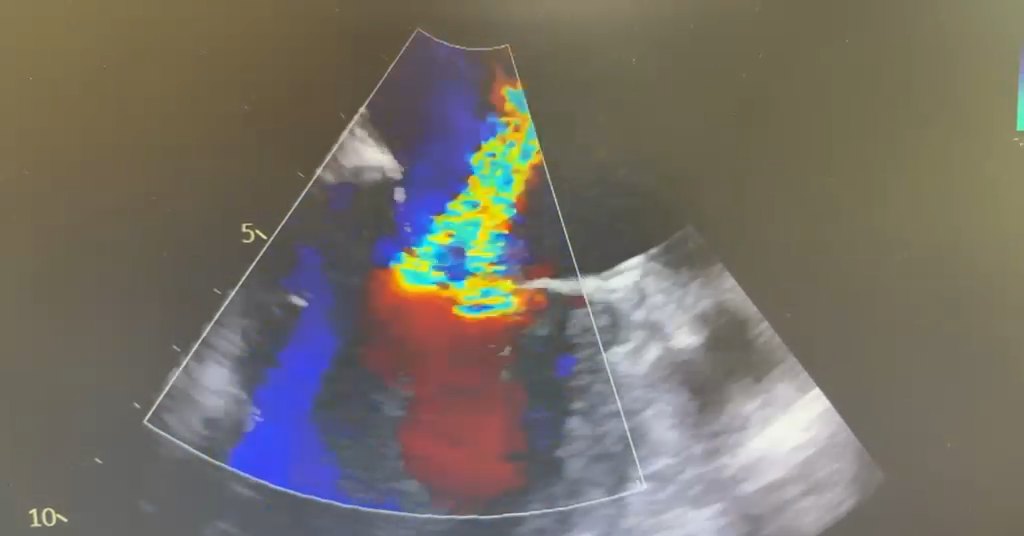
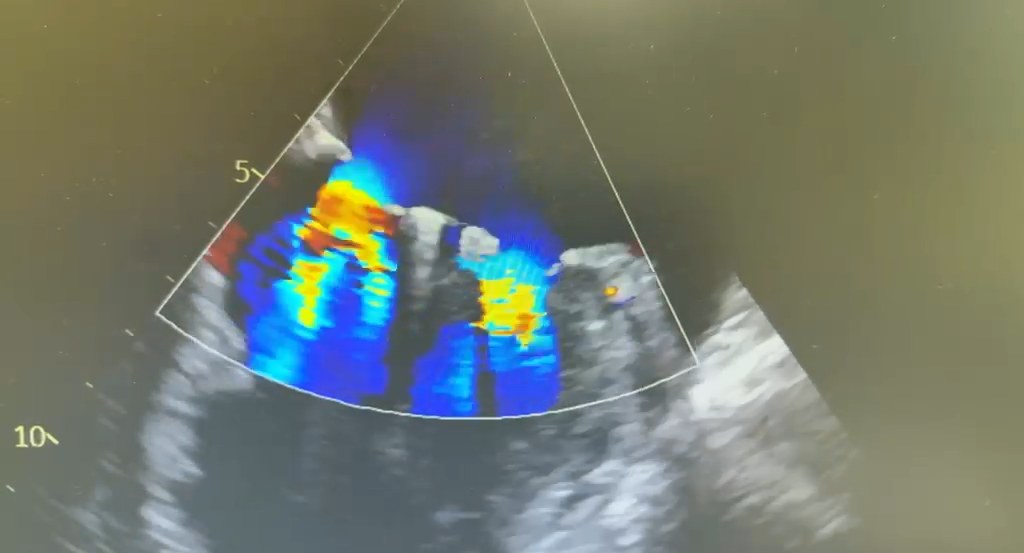
BeforeAfter 2 clips
← drag to compare →
What this case teaches
Restoring flow through the dominant LAD under support gives the ventricle its best chance before the valve is addressed.
With iliofemoral disease, a single-access approach let the team do protected PCI with fewer large-bore punctures.
Rotablation, a cutting balloon and lithotripsy, guided by IVUS, prepared the vessel for a well-expanded stent.
A wide jet often needs two clips. Anticipating a lateral residual jet made the second clip a planned step rather than a surprise.
Complex coronary and valve disease, treated together
Our heart team combines high-risk PCI, mechanical circulatory support and structural interventions for patients who are often considered too sick for conventional surgery.
Next in this series · Case 2Two Leaking Valves, Two New Devices: HANCOR TAVR and NeoNova TEER →
This case is shared for medical education. Images and clips are de-identified procedural recordings. Individual outcomes vary, and treatment decisions should be made with your cardiologist.