


 15 November, 2026
Two Leaking Valves, Two New Devices: HANCOR TAVR and NeoNova TEER for Pure AR and MR
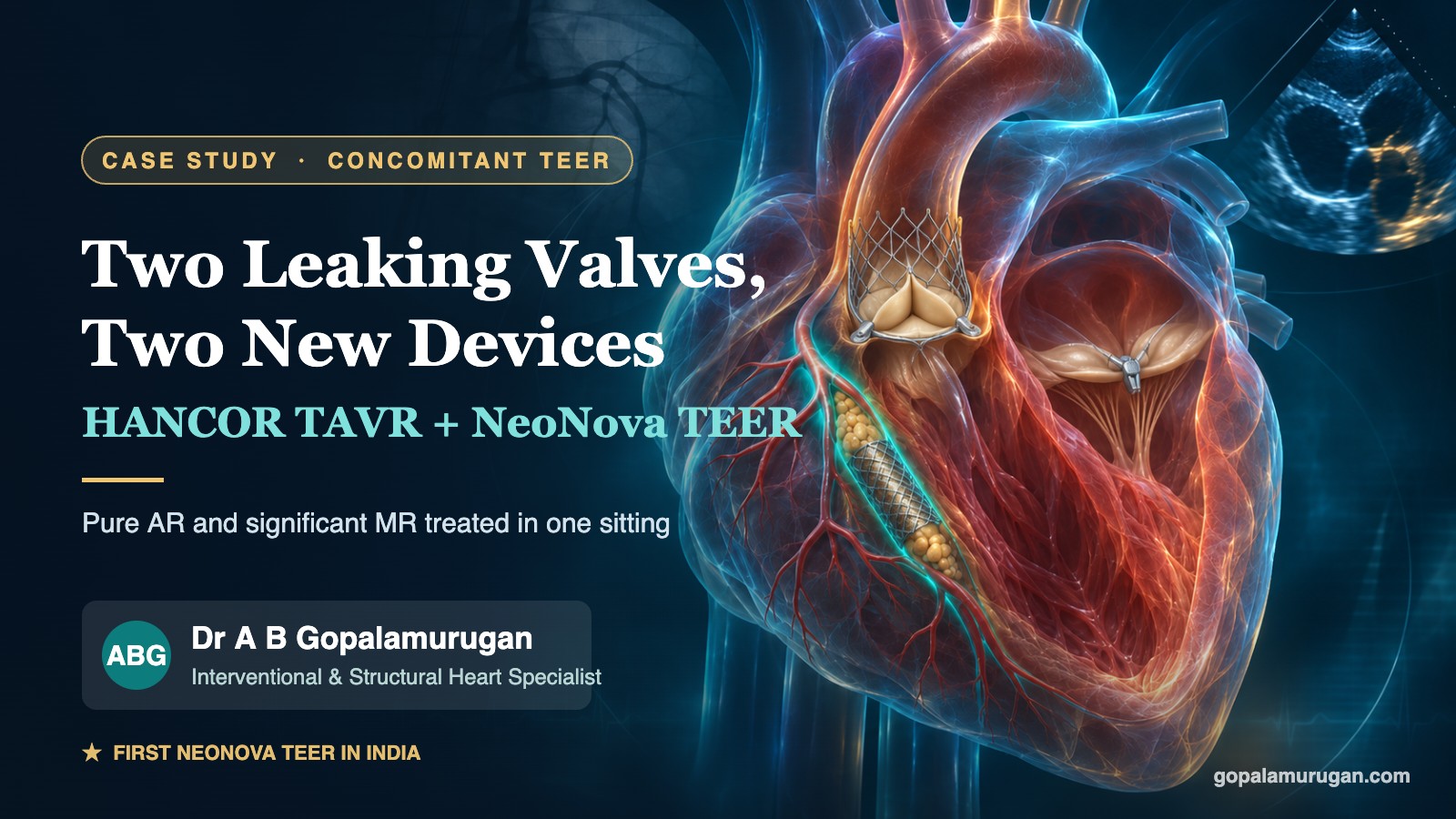
Two leaking valves, a patient considered high risk for open-heart surgery, and two new devices. This is how the team treated pure aortic regurgitation and significant mitral regurgitation in a single sitting, without opening the chest.
Two regurgitant valves and a high-risk surgical route
A 70-year-old patient with morbid obesity had significant aortic regurgitation (AR) and significant mitral regurgitation (MR), with a dilated, impaired left ventricle.
The surgical option was a big one: a Bentall procedure (the aorta measured 5 cm) together with mitral valve replacement. The patient was quoted high risk for surgery, decided against it and looked for alternatives.
On referral, the team offered TAVR, with or without TEER. The aortic valve would be treated first, and the mitral valve only if the MR was still significant on the table after TAVR.
⚠️ Why pure AR is hard for TAVR: standard TAVR valves are usually anchored by calcium on a narrowed aortic valve. In pure aortic regurgitation there is often little or no calcium to grip, so a dedicated anchoring approach is needed.
HANCOR TAVR: dock first, then sandwich the leaflets
The patient had a horizontal aorta, which can make it harder to line up and position a transcatheter valve. A 26 mm HANCOR device was chosen according to CT sizing.
“After the sinus docks were deployed, valve deployed to sandwich the leaflets between the dock and the valve.”Procedure note, Dr A B Gopalamurugan
Was the MR still significant after TAVR?
Treating aortic regurgitation can sometimes reduce mitral regurgitation, because it lowers the volume load on the left ventricle. That is why the plan was to reassess on the table. Here, the MR was still significant after TAVR, so the team proceeded with TEER in the same sitting.
NeoNova TEER: India’s first
The significant MR was treated with the NeoNova TEER device, using a single clasp, 6 mm wide and 10 mm long. According to the team, this was the first NeoNova device used in India.
Like other TEER systems, it is delivered through a vein and across the heart’s inner wall to the mitral valve, where it grasps the two leaflets and holds them together to reduce the leak.
What this case teaches
When open surgery (Bentall plus MVR) carried high risk, a combined transcatheter approach still treated both valves.
Sinus docks let the valve sandwich the native leaflets, giving a secure seat without calcium.
Deciding on TEER on the table after TAVR avoids an unnecessary mitral procedure if the MR settles.
HANCOR and NeoNova add options for anatomy and pathology that older devices handled less well.
“Two not so uncommon scenarios where surgery was high risk where not so uncommon concomitant procedures with TEER provided a wholistic solution.”Dr A B Gopalamurugan
Two leaking valves? There may be a non-surgical path
Our structural heart team assesses patients with aortic and mitral regurgitation who are high risk for surgery, and plans combined transcatheter treatment where it fits.
Previous in this series · Case 1Impella-Assisted PCI and TEER in Cardiogenic Shock →
This case is shared for medical education. Images and clips are de-identified procedural recordings. Individual outcomes vary, and treatment decisions should be made with your cardiologist.