


 18 April, 2026
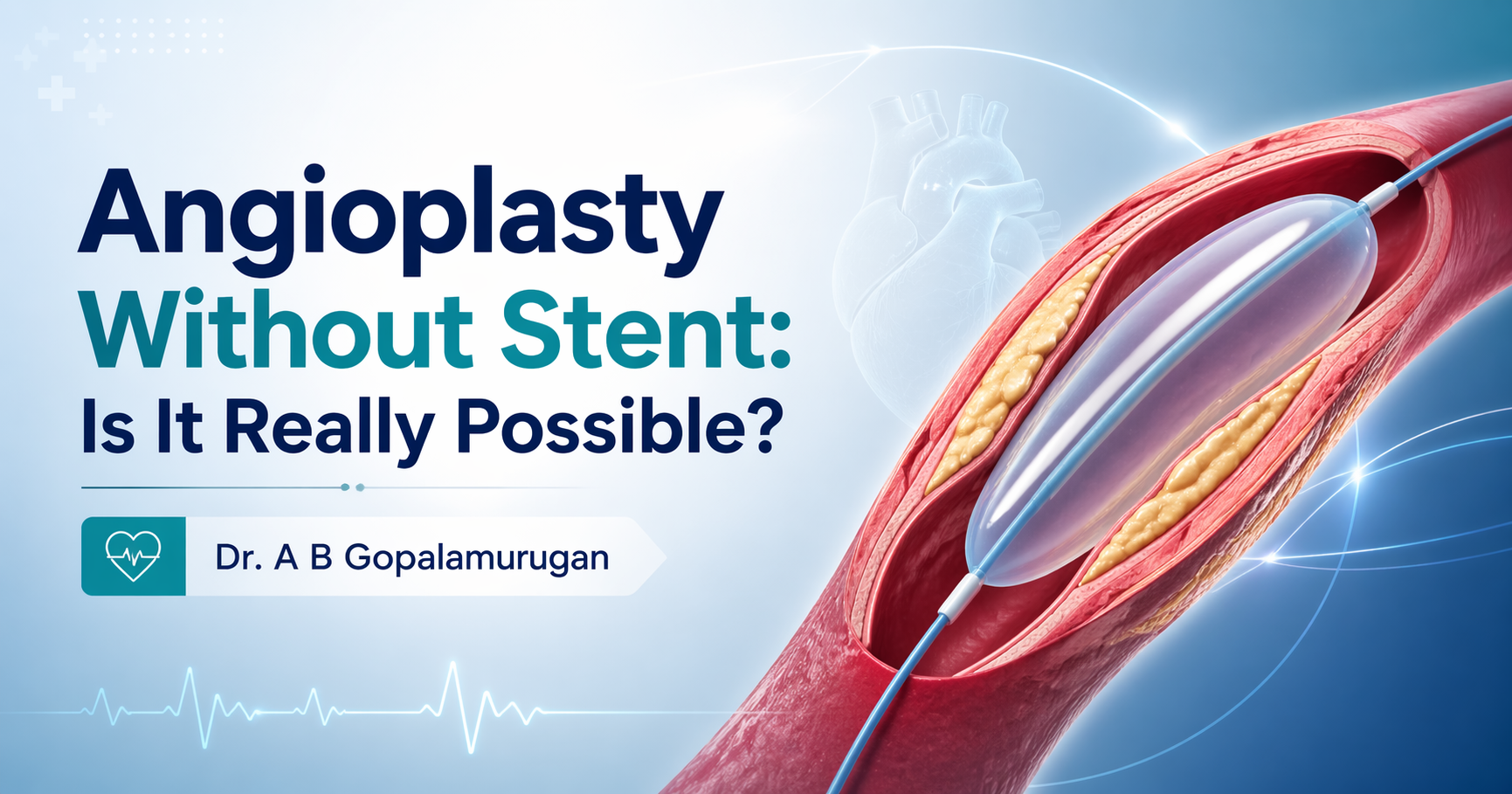
Angioplasty Without Stent: Is It Really Possible? | Dr. A B Gopalamurugan
When patients hear the word angioplasty, they almost automatically think of a stent. In fact, one of the most common questions patients ask is:
Can angioplasty be done without stent?
The answer is yes — in selected cases, it is possible. But this is also where the discussion becomes more important and more nuanced. Just because angioplasty without stent can be done does not mean it is the right option for every patient or every blockage.
In modern cardiology, treatment decisions are rarely one-size-fits-all. The real question is not simply whether a stent can be avoided. The real question is: what is the safest, most effective, and most durable treatment for that specific artery in that specific patient?
That is what makes this topic so important.
Understanding What Happens During Angioplasty
Before discussing balloon angioplasty without stent, it helps to understand what angioplasty actually is.
Angioplasty is a minimally invasive procedure used to open a narrowed or blocked coronary artery — the blood vessels that supply the heart muscle. If one of these arteries becomes significantly narrowed because of plaque buildup, blood flow to the heart can reduce. This may cause chest pain, breathlessness, reduced exercise capacity, or even a heart attack.
During angioplasty, a thin tube called a catheter is passed through a blood vessel and guided to the narrowed artery. A small balloon is then inflated at the site of blockage to widen the artery and improve blood flow.
Traditionally, after opening the artery with the balloon, a stent is often placed. A stent is a tiny mesh tube that helps keep the artery open. In many cases, this is the standard and most effective approach.
However, there are situations where the artery may be treated without leaving a permanent stent behind.
Why Are Stents Commonly Used?
To understand angioplasty without stent, it is important to know why stents became such a major part of heart treatment in the first place.
In the early days of angioplasty, doctors relied mainly on balloons alone. While the artery could be opened initially, some vessels had a tendency to narrow again, recoil, or develop problems after treatment. Stents helped overcome many of these issues by acting like a scaffold inside the artery.
Today, stents are commonly used because they:
- Help keep the artery open
- Reduce vessel recoil
- Lower the chance of sudden closure after angioplasty
- Offer a durable result in many routine cases
- Often reduce the chance of repeat narrowing compared with balloon-only treatment
This is why stents remain a trusted and highly effective treatment in a large number of patients.
So when we talk about angioplasty without stent, we are not talking about replacing stents in every case. We are talking about carefully selected situations where a stent-free result may be possible and appropriate.
What Does Angioplasty Without Stent Mean?
When people search for angioplasty without stent, they may be referring to two related but slightly different approaches.
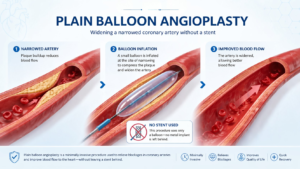
1. Plain Balloon Angioplasty
This is the older and more straightforward concept. The narrowed artery is opened with a balloon, and no stent is placed afterward. The treatment ends there if the result is satisfactory.
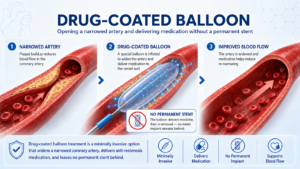
2. Drug-Coated Balloon Strategy
This is a more modern stentless approach. In this method, the artery is prepared and then treated with a special balloon that delivers medication directly to the artery wall. The medication helps reduce the chance of re-narrowing, but no metal implant is left behind.
This is often seen as a “leave nothing behind” approach, which can be appealing in selected patients.
Can Angioplasty Be Done Without Stent?
Yes, angioplasty can be done without stent — but not in all patients.
Whether it is possible depends on several important factors:
- The size of the artery
- The location of the blockage
- Whether the lesion is simple or complex
- How the artery behaves after balloon treatment
- Whether there is recoil or tearing in the vessel wall
- Whether blood flow is excellent after the balloon is used
- Whether the patient has had previous stents in that area
So the answer is not just about possibility. It is about suitability.
When Is Balloon Angioplasty Without Stent Considered?
There are certain clinical situations where balloon angioplasty without stent may be a reasonable option.
Small Vessel Disease
Some arteries are very small. In such vessels, placing a stent may not always be ideal. A balloon-only or drug-coated balloon approach may sometimes be considered if the artery responds well and the final result is stable.
In-Stent Restenosis
This is when a previously placed stent becomes narrow again. In such cases, doctors may want to avoid adding another layer of metal if possible. A drug-coated balloon may sometimes be used to treat the narrowing without inserting an additional stent.
Selected Simple Lesions
In very carefully chosen cases, if the blockage is opened well with the balloon and the artery remains stable, a stent may not be required. This decision depends entirely on how the artery looks and behaves during the procedure.
Patients Where Avoiding a Permanent Implant May Be Helpful
There are situations where avoiding a permanent stent may be beneficial, but this should always be judged by an experienced interventional cardiologist.
What Are the Advantages of Angioplasty Without Stent?
In the right patient, angioplasty without stent can offer some meaningful benefits.
No Permanent Metal Left Behind
One of the main attractions of a stentless approach is that no permanent implant remains in the artery. This may help preserve the natural structure and flexibility of the vessel.
Less Metal in Previously Treated Arteries
In patients who already have a stent and develop re-narrowing, avoiding another stent may prevent the artery from ending up with multiple layers of metal.
A More Natural Vessel Outcome in Selected Cases
If the artery is suitable and responds well, the result can be effective without the need for a scaffold.
Potentially Useful in Certain High-Bleeding-Risk Situations
In selected cases, treatment strategy may also be influenced by bleeding risk and medication planning, though this is always individualized.
What Are the Limitations?
This is where caution matters.
Many patients assume that avoiding a stent automatically means a better or simpler treatment. That is not always true.
In some arteries, a balloon alone may not be enough. The vessel may recoil after the balloon is removed. There may be a tear in the artery wall. The blood flow may not be ideal. The blockage may be long, calcified, complex, or unstable. In such situations, a stent may be the safer and more reliable option.
The biggest limitation is this: not every artery is suitable for a stent-free result.
That is why this decision should never be based on preference alone. It must be based on anatomy, lesion type, safety, and long-term outcome.
Is Angioplasty Without Stent Better Than Stent Angioplasty?
Not necessarily.
This is the wrong way to compare the two.
A stent is not “bad,” and balloon-only treatment is not automatically “better.” Both are tools. What matters is using the right tool for the right problem.
For many patients, a modern stent remains the best treatment. It gives a strong, predictable, and durable result. For some patients, especially in selected situations, angioplasty without stent may be an excellent option.
So the real goal is not to avoid a stent at all costs. The real goal is to choose the treatment that gives the safest and most durable outcome for that patient.
How Do Cardiologists Decide?
As an interventional cardiologist, I do not look at this question in a simplistic way.
If a patient asks me, “Can angioplasty be done without stent?”, I first evaluate:
- What does the angiogram show?
- Is the artery large or small?
- Is the blockage short, focal, long, diffuse, or calcified?
- Is this a new blockage or a previously treated segment?
- How well does the artery open with initial balloon preparation?
- Is the final blood flow excellent?
- Is there any dissection, recoil, or instability?
Only after answering these questions can a responsible decision be made.
In some cases, I may begin with the hope of achieving a stentless result — but if the artery does not behave safely, I must be prepared to place a stent. That flexibility is important. Good cardiology is not about forcing one method. It is about adapting to what the artery needs.
A Word of Reassurance for Patients
Patients are often anxious when they hear about procedures involving the heart. Some worry about having a stent for life. Others worry that without a stent the artery may close again. These concerns are natural.
What matters most is not whether the treatment sounds simpler. What matters is whether it is safe, appropriate, and durable.
A properly chosen treatment plan — whether it involves a stent or not — should always be based on what gives the patient the best balance of immediate success and long-term benefit.
So, Is It Really Possible?
Yes, angioplasty without stent is really possible.
But it is not a routine answer for every blockage.
It is a selective strategy used in the right anatomy, the right lesion type, and the right clinical situation. For many coronary blockages, stents remain the standard and most reliable treatment. For others, particularly selected small vessels, re-narrowing inside previous stents, or certain favorable lesions, a stent-free approach may be possible.
That is why patients should not focus only on the question:
“Can angioplasty be done without stent?”
They should also ask:
“What is the best treatment for my artery and my long-term heart health?”
That is the question that truly matters.
FAQs on Angioplasty Without Stent
1. Can angioplasty be done without stent?
Yes, in selected cases, angioplasty can be done without stent. However, this depends on the artery, the blockage pattern, and how well the vessel responds during the procedure.
2. What is balloon angioplasty without stent?
Balloon angioplasty without stent is a procedure where the narrowed artery is widened using a balloon, but no permanent stent is placed afterward.
3. Is angioplasty without stent safe?
It can be safe in carefully chosen patients. The safety depends on proper case selection and on how stable the artery looks after balloon treatment.
4. Why do most angioplasty procedures use stents?
Stents help keep the artery open and reduce the risk of recoil or re-narrowing. That is why they are commonly used in many standard cases.
5. Is angioplasty without stent better than stent angioplasty?
Not necessarily. One is not automatically better than the other. The right treatment depends on the type of blockage and what is safest for the patient.
6. In which situations is angioplasty without stent more likely to be considered?
It may be considered in small vessel disease, in-stent restenosis, and some carefully selected lesions where the artery responds very well to balloon treatment.
7. What is a drug-coated balloon?
A drug-coated balloon is a special balloon that delivers medication to the artery wall during angioplasty, helping reduce re-narrowing without leaving a permanent implant behind.
8. Will I still need medicines after angioplasty without stent?
Yes. Even if no stent is used, medicines remain an important part of treatment. Patients usually still need medications for heart protection and risk-factor control.
9. Can the artery narrow again if no stent is used?
Yes, that is possible in some cases. This is one reason why balloon-only treatment is not suitable for everyone.
10. Does angioplasty without stent mean my heart disease is cured?
No. Angioplasty improves blood flow in a narrowed artery, but it does not cure the underlying process of atherosclerosis. Long-term heart care, lifestyle changes, and medicines remain important.
About Dr A.B. Gopalamurugan
Dr A.B. Gopalamurugan is a Senior Interventional Cardiologist and Electrophysiologist with over 20 years of experience in advanced heart care. He is known for his expertise in Interventional Cardiology, TAVR, Electrophysiology, and Endovascular Aortic Repairs.
With a patient-focused and evidence-based approach, Dr Gopalamurugan is committed to offering advanced, thoughtful, and individualized treatment for a wide range of heart conditions, including coronary artery disease, complex angioplasty, heart rhythm disorders, and structural heart disease.
Qualifications
MD, MRCP, FRCP, CCDS, FACC
Consultation Locations
London
W1 Healthcare, 7 Russell Gardens,
London W14 8EZ, United Kingdom
Phone: +44 7425 861747
Chennai
2nd Floor, 46 & 48, Masilamani Rd, Balaji Nagar, Royapettah,
Chennai, Tamil Nadu 600014
Phone: 080560 88898
Mumbai
81-84, Indian Cancer Society Formerly Lady Ratan Tata Medical & Research Centre,
M.K. Karve Road, Cooperage St,
Mumbai, Maharashtra 400021
Phone: 089400 88898