


 16 September, 2026
India’s First MitraClip Post Cardiac Transplant Performed Successfully | A Landmark TEER Procedure by Dr. A. B. Gopalamurugan
Heart transplantation can give patients with advanced heart failure a new lease on life. But even years after a successful transplant, the transplanted heart can develop new and complex cardiac problems that require highly specialised treatment.
In an important structural-heart milestone, Dr. A. B. Gopalamurugan and the Heart Team successfully performed a Transcatheter Edge-to-Edge Repair (TEER) using the MitraClip device in a patient who had previously undergone cardiac transplantation.
The case is being presented as:
“India’s First MitraClip Post Cardiac Transplant Performed Successfully.”
What makes this achievement particularly significant is not simply the use of MitraClip, but the extraordinary complexity of performing a transcatheter mitral valve repair in a heart-transplant recipient with advanced heart failure and challenging post-transplant anatomy.
The Patient: A Heart Transplant Recipient Facing a New Cardiac Challenge
The patient was only 35 years old and had undergone a heart transplant in Berlin in 2002.
Years after transplantation, the patient developed progressive cardiac problems, including severe mitral regurgitation, where the mitral valve was no longer closing properly.
The mitral valve is located between the heart’s left atrium and left ventricle. Normally, it closes tightly when the heart pumps so that blood moves forward.
When the valve fails to close adequately, some blood leaks backwards into the left atrium. This condition is known as mitral regurgitation or MR.
When severe, mitral regurgitation can place additional stress on an already weakened heart and may contribute to symptoms such as breathlessness, fatigue, reduced exercise capacity and recurrent heart-failure episodes.
In this particular patient, the clinical situation was significantly more complicated because the mitral regurgitation developed in the setting of a previously transplanted heart.
The patient had also developed transplant-related coronary artery disease/vasculopathy and had previously required coronary interventions.
Despite medical treatment, the patient’s heart-failure symptoms had progressed to an advanced stage.
This was therefore far from a routine case of mitral regurgitation.
Why Was Conventional Surgery Challenging?
For many patients with severe mitral valve disease, conventional cardiac surgery may be considered.
But treatment cannot be based on the valve alone.
Doctors have to consider the patient’s overall heart function, previous procedures, medical conditions, surgical risk and anatomy.
For someone who has already undergone a heart transplant, another major cardiac operation can represent a particularly complex clinical decision.
This is where a multidisciplinary Heart Team approach becomes crucial.
The objective is not simply to ask:
“Can we repair the valve?”
The more important question is:
“What treatment offers the patient meaningful clinical benefit with an acceptable level of procedural risk?”
After detailed evaluation and optimisation of the patient’s heart-failure treatment, a catheter-based approach to reduce the mitral regurgitation was considered.
The chosen procedure was Transcatheter Edge-to-Edge Repair — TEER — using the MitraClip device.
What Is TEER?
TEER stands for Transcatheter Edge-to-Edge Repair.
It is an advanced minimally invasive technique used to treat selected patients with significant mitral regurgitation.
Unlike conventional mitral valve surgery, TEER does not require the chest to be opened to reach the valve.
Instead, the procedure is performed using a catheter.
Access is generally obtained through a vein in the groin. The catheter is carefully advanced towards the heart and then across the atrial septum to reach the left side of the heart and the mitral valve.
The entire procedure requires highly precise real-time imaging.
Once the mitral valve has been carefully assessed, the repair device is positioned at the area where the valve leaflets are failing to meet correctly.
What Is MitraClip?
MitraClip is the device used to perform this particular type of TEER procedure.
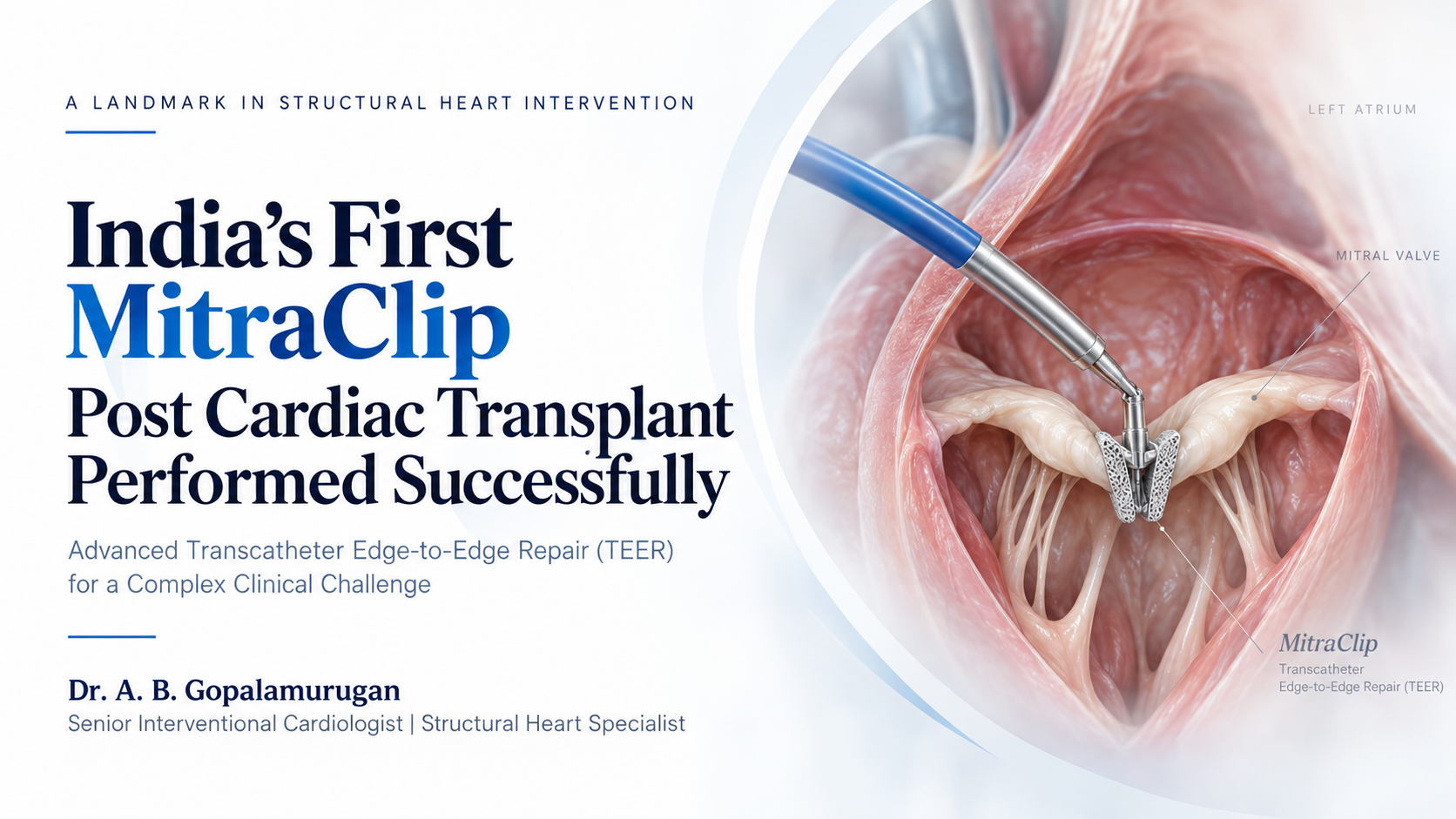
The MitraClip is positioned on the mitral valve and grasps portions of the anterior and posterior mitral valve leaflets.
By bringing the appropriate sections of the two valve leaflets closer together, the device can improve valve closure and reduce the amount of blood leaking backwards through the mitral valve.
The objective is not simply to place a clip.
The interventional team must achieve the right balance between:
- reducing mitral regurgitation sufficiently;
- maintaining adequate forward blood flow;
- avoiding excessive narrowing of the valve; and
- ensuring stable attachment of the device.
This makes TEER a procedure in which patient selection, imaging, anatomy, device positioning and operator experience are all critical.
Why Was TEER After a Heart Transplant So Complex?
Every TEER procedure requires precision.
But performing TEER in a transplanted heart creates another level of technical complexity.
The anatomy after cardiac transplantation can be substantially different from that of a non-transplanted heart.
In this case, the patient had particularly challenging atrial anatomy following transplantation.
The distance from the transseptal puncture area to the mitral valve was unusually long — more than 7 cm.
This is important because the TEER delivery system has to be navigated precisely through the atrium before approaching the mitral valve at the correct orientation.
Even a relatively small difference in catheter angle or position can affect the ability to properly capture the mitral leaflets.
Therefore, the procedure required:
Detailed pre-procedure planning → precise transseptal access → advanced echocardiographic guidance → accurate device steering → careful leaflet capture → immediate assessment of mitral regurgitation and valve gradients.
This is why complex structural-heart procedures such as TEER are generally undertaken by experienced teams familiar with advanced transcatheter valve interventions.
A Treatment Strategy Built Around the Patient
One of the most important lessons from this case is that modern structural-heart intervention is not about using a new device simply because it is available.
The treatment plan has to be individualised.
The Heart Team first considered the patient’s overall heart function, symptoms, transplant history, coronary disease, valve anatomy and procedural risks.
Medical and heart-failure therapies were optimised.
Only after detailed evaluation was MitraClip TEER selected as the appropriate strategy to reduce the severe mitral regurgitation without subjecting the patient to another major open-heart operation.
This type of decision-making represents an increasingly important direction in modern cardiology:
The right procedure, for the right patient, at the right time.
Successfully Repairing a Mitral Valve Without Reopening the Chest
The MitraClip procedure was successfully completed, achieving the intended reduction in mitral regurgitation through a transcatheter approach.
For a patient with a transplanted heart and advanced cardiac disease, being able to address significant mitral valve leakage without another conventional open-heart procedure represents an important therapeutic option.
It also demonstrates how structural-heart technologies are expanding the possibilities available to patients once considered extremely difficult to treat.
However, TEER is not automatically suitable for every patient with mitral regurgitation.
Detailed echocardiographic assessment, evaluation of the cause of mitral regurgitation, heart function, valve anatomy, symptoms and overall medical condition are required before the procedure can be considered.
The Expertise Behind Complex TEER Procedures
Dr. A. B. Gopalamurugan is a Senior Interventional Cardiologist with a major focus on complex cardiac interventions, structural-heart procedures and transcatheter valve therapies.
His work encompasses advanced catheter-based treatment of cardiac conditions including transcatheter aortic, mitral and other structural-heart interventions.
TEER is particularly demanding because successful treatment involves much more than manipulating a catheter.
It requires close coordination between the interventional cardiologist, cardiac imaging specialists, anaesthesia team, heart-failure specialists and other members of the Heart Team.
In highly complex cases such as a previous cardiac transplant, experience in understanding unusual anatomy and planning transcatheter interventions becomes particularly important.
Why This Case Matters
This case demonstrates how rapidly the treatment of structural heart disease is evolving.
A patient who has already undergone one of medicine’s most complex operations — a heart transplant — later developed severe mitral valve disease.
Rather than accepting the valve problem as untreatable or automatically exposing the patient to another major cardiac operation, the Heart Team explored an advanced transcatheter solution.
Using TEER with the MitraClip device, the mitral valve was treated through a minimally invasive catheter-based approach.
For patients and physicians alike, the larger message is important:
Complex heart disease does not always mean there are no further treatment options.
With careful evaluation, advanced imaging, multidisciplinary decision-making and expertise in structural-heart intervention, selected patients may have catheter-based treatment possibilities that were not available in the past.
Frequently Asked Questions
What does TEER stand for?
TEER stands for Transcatheter Edge-to-Edge Repair. It is a catheter-based procedure used to repair selected leaking heart valves, most commonly the mitral valve.
Is MitraClip the same as TEER?
TEER is the name of the procedure or technique. MitraClip is a device used to perform mitral TEER.
Does MitraClip replace the mitral valve?
No. MitraClip does not replace the valve. It repairs the patient’s existing mitral valve by bringing selected sections of the valve leaflets together to reduce leakage.
Is open-heart surgery required for MitraClip?
MitraClip TEER is performed through a catheter-based approach and ordinarily does not require conventional open-heart surgery.
Why would TEER be considered instead of surgery?
For selected patients, surgery may carry significant risk because of advanced heart failure, previous heart operations, age, other medical conditions or complex clinical circumstances. The Heart Team evaluates whether a transcatheter repair may be more appropriate.
Can every patient with mitral regurgitation receive MitraClip?
No. Patient selection is extremely important. The severity and cause of mitral regurgitation, valve anatomy, heart function, symptoms and overall clinical condition must all be evaluated.
Can mitral valve problems occur even after heart transplantation?
Yes. A transplanted heart can develop cardiac problems years later, including coronary disease, graft-related complications, heart failure and valve dysfunction. These patients require specialised long-term cardiac follow-up.
Who should evaluate a patient for TEER?
Evaluation is ideally undertaken by a multidisciplinary structural-heart or Heart Team experienced in mitral valve disease, advanced cardiac imaging and transcatheter intervention.
A Milestone in Complex Structural Heart Intervention
India’s First MitraClip Post Cardiac Transplant Performed Successfully
The successful TEER procedure performed by Dr. A. B. Gopalamurugan and the Heart Team highlights what can become possible when advanced structural-heart technology is combined with meticulous planning and experienced clinical decision-making.
For this young heart-transplant recipient, an extraordinarily complex mitral valve problem could be approached without another conventional open-heart operation.
And for the wider field of cardiology, this case represents another step forward in extending advanced transcatheter valve therapy to increasingly complex groups of patients.
Dr. A. B. Gopalamurugan
Senior Interventional Cardiologist & Structural Heart Specialist
Advanced Cardiac Interventions | TEER – MitraClip | Transcatheter Valve Therapies | Complex Structural Heart Procedures
Medical Disclaimer: This article is intended for patient education and awareness. TEER/MitraClip is appropriate only for selected patients after detailed clinical and imaging assessment. Individual treatment decisions should be made in consultation with an experienced cardiologist and multidisciplinary Heart Team.