


 8 October, 2026
Heart Failure and a Leaking Mitral Valve: 6 Myths About Secondary MR
Your report says “severe MR” and “weak heart”. Which one is really the problem?
Written by Dr. A. B. Gopalamurugan, Interventional Cardiologist · 6 min read
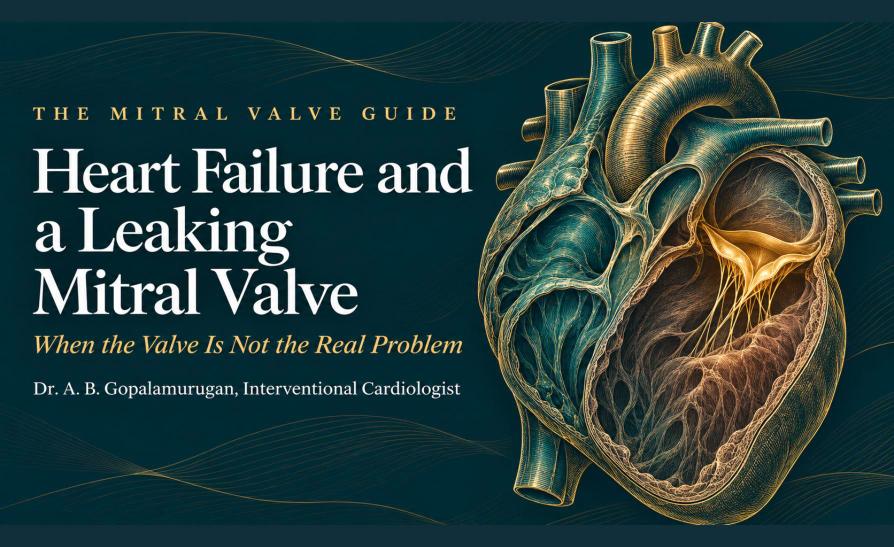
Many people with heart failure are told they also have a leaking mitral valve. It is natural to assume that the valve caused the weakness. Often, it is the other way round.
This is called secondary (functional) mitral regurgitation. The valve leaflets may be fairly normal, but an enlarged heart stretches them apart so they can’t meet. Here are the myths that most often confuse patients and families.
- In secondary MR, a weak heart muscle causes the leak.
- Heart failure treatment comes first and may reduce the leak.
- If symptoms continue, TEER may help selected patients.
- Not every patient benefits, so careful selection matters.
How a weak heart makes a valve leak
The mitral valve depends on the heart around it. Its two leaflets are anchored by fine cords to muscles in the left ventricle, the heart’s main pumping chamber. When this chamber weakens and enlarges after a heart attack or from cardiomyopathy, those muscles are pulled apart and the valve ring stretches.
The leaflets are then tethered away from each other, and a gap opens at the centre. Blood leaks backwards with every beat. The extra leak adds to the heart’s workload, which can enlarge it further. This is why secondary MR can feed a vicious circle.
Primary MR
- The valve itself is diseased
- Examples: prolapse, torn cords
- Fixing the valve treats the main problem
Secondary MR
- The heart muscle is the main problem
- Often follows heart failure or a heart attack
- The heart and the valve both need attention
Tests your doctor may advise
Echocardiogram
The key test. It shows the heart’s size and pumping strength, and how severe the leak is.
TOE
A probe in the food pipe gives close-up views of the valve, especially when planning treatment.
Coronary angiogram
Checks for blocked arteries, which may contribute to a weak heart.
Blood tests and ECG
Help assess heart strain, kidney function and heart rhythm.
What patients often believe
Treat the heart first. Then ask what the valve still needs.
How treatment usually moves forward
- Confirm the cause. Echo and related tests show whether the leak is primary or secondary, and blocked arteries are checked where needed.
- Optimise heart failure treatment. Medicines are adjusted carefully over time, and devices such as CRT are considered for suitable patients.
- Reassess. The leak and your symptoms are checked again on optimal treatment.
- Discuss further options. If severe MR and symptoms continue, the Heart Team considers TEER, surgery or advanced heart failure care.
Treatments, explained simply
Heart failure medicines
Combinations may include ARNI or ACE inhibitors, beta blockers, MRAs, SGLT2 inhibitors and water tablets, chosen for each patient.
Treating blocked arteries
Angioplasty or bypass may help when reduced blood supply is part of the problem.
CRT
A special pacemaker helps both sides of the heart beat together in suitable patients, and may reduce the leak.
TEER
A clip such as MitraClip, placed through a groin vein, joins the leaflets to reduce the leak.
Mitral valve surgery
May be considered, particularly when heart surgery is already needed for another reason.
Advanced therapies
LVAD or heart transplant may be assessed in advanced heart failure.
What the Heart Team looks at
- Are symptoms continuing despite optimal heart failure treatment?
- How severe is the leak compared with the size of the heart?
- How strong is the heart’s pumping function?
- Is the valve anatomy suitable for a clip?
- What are your other health conditions and your own goals?
A clip works best when the leak is a major part of the problem. If the heart muscle is very badly damaged, the benefit may be limited, and other options may be better.
Daily habits that help your heart
- Take your medicines at the same time every day.
- Check your weight as advised, and report sudden gain.
- Follow your doctor’s advice on salt and fluids.
- Stay active within the limits your team sets.
- Avoid smoking, and ask about vaccinations.
- Is my leak primary or secondary?
- Am I on the best possible heart failure treatment?
- What is my pumping strength now, and how has it changed?
- Would CRT or TEER help me?
- When should my echo be repeated?
Signs that need prompt review
- Increasing breathlessness, especially lying flat
- Swelling of the feet or sudden weight gain
- Waking up breathless at night
- Repeated hospital admissions for heart failure
Severe breathlessness, chest pain or fainting is an emergency. Go to the nearest emergency department straight away.
What families ask
Is secondary MR the same as a damaged valve?
No. In secondary MR, the main problem is usually the enlarged heart, not the leaflets.
Can the leak improve without a procedure?
Sometimes, yes. Optimal medicines and, in suitable patients, CRT can reduce it.
Is TEER a cure for heart failure?
No. It can reduce the leak and help selected patients, but heart failure care continues afterwards.
Is age a barrier to treatment?
Age alone doesn’t decide. Your overall health and heart condition matter more.

Dr. A. B. Gopalamurugan
Senior Consultant Interventional Cardiologist, Chennai, with 16 years of training and practice in London, UK.
- MD, University of London, for British Heart Foundation funded research at St Thomas’ Hospital
- Founder and course director of India Valves, a national course on transcatheter valve therapies
- Performed India’s first transcatheter tricuspid valve implantation (2016) and mitral valve implantation (2017)
- Runs HeartTeam India, a team-based approach to complex heart care
Living with heart failure and severe MR?
Share your echo reports with Dr. A. B. Gopalamurugan for a Heart Team opinion. For OP appointments, call +91 91760 88898 or contact the clinic.
This article is for general education and isn’t a substitute for personal medical advice. Please consult your cardiologist about your specific condition.