

 13 May, 2026
India’s First Dedicated TAVR/TAVI for Pure Aortic Regurgitation: A Landmark Heart Team Achievement
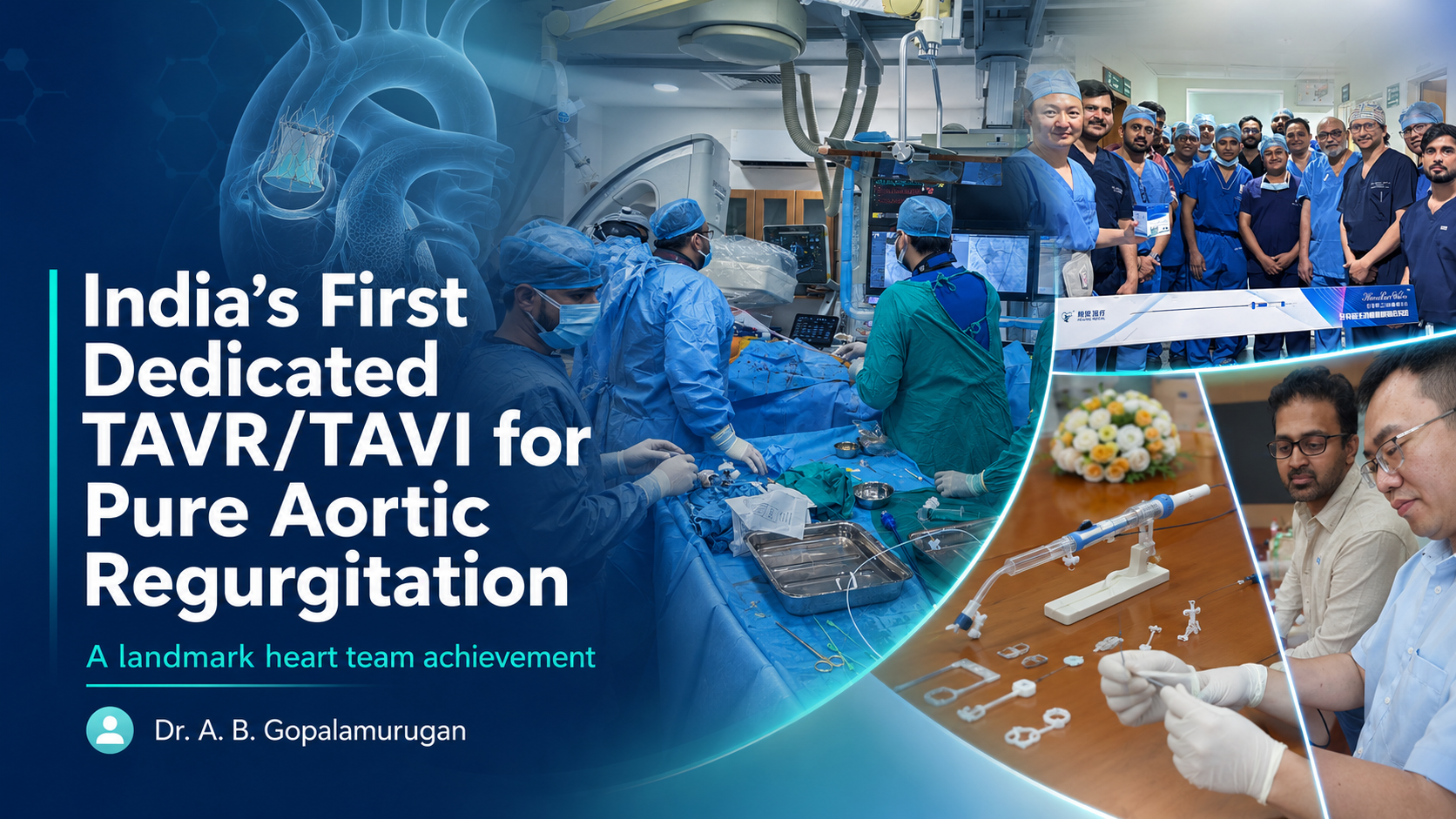
I am extremely happy to share a very special and fulfilling milestone in my journey in structural heart interventions. I was privileged to be part of the heart team that successfully performed India’s first dedicated TAVR/TAVI for pure Aortic Regurgitation.
This was not just another valve procedure. It was a landmark moment because pure Aortic Regurgitation has always been one of the most challenging conditions to treat using conventional TAVR/TAVI devices. Many patients with this condition do not have enough aortic valve calcium, which makes it difficult for regular TAVR devices to anchor securely.
The dedicated TAVI device used in this case is designed differently. It uses an anchoring mechanism that latches onto the aortic valve leaflets, making it suitable for selected patients with pure Aortic Regurgitation and little or no aortic valve calcium.
For me, this was an extremely fulfilling journey — from bench testing in China several months ago to successfully treating the first patient in India with this dedicated TAVI device.
Most importantly, this milestone gives hope to many patients who may not have been suitable candidates for conventional TAVR/TAVI devices.
“India’s first dedicated TAVR/TAVI for pure Aortic Regurgitation”
“Performed by an expert heart team”
“Dedicated valve technology for selected patients with no aortic valve calcium”
Understanding Aortic Valve Disease
The aortic valve is one of the most important valves in the heart. It controls blood flow from the left ventricle, the main pumping chamber of the heart, into the aorta, which carries oxygen-rich blood to the rest of the body.
When the aortic valve becomes diseased, it can affect the heart’s ability to pump blood efficiently. Two important types of aortic valve disease are:
- Aortic Stenosis
- Aortic Regurgitation
In Aortic Stenosis, the valve becomes narrowed and stiff. The heart has to work harder to push blood through the tight valve opening.
In Aortic Regurgitation, the valve does not close properly. Because of this, blood leaks backward into the heart after each heartbeat.
Both conditions can become serious if not diagnosed and treated at the right time.
What Is Aortic Regurgitation?
Aortic Regurgitation, also called AR, is a condition where the aortic valve leaks. Instead of blood moving forward into the aorta and then to the rest of the body, some of the blood flows backward into the heart.
Over time, this backward leakage can put extra pressure on the left ventricle. The heart has to pump more blood than usual, and gradually, the heart muscle may enlarge and weaken.
Patients with significant Aortic Regurgitation may experience:
- Breathlessness
- Fatigue
- Reduced stamina
- Chest discomfort
- Palpitations
- Swelling in the legs
- Difficulty lying flat
- Worsening heart failure in advanced cases
Some patients may not have symptoms in the early stages. That is why regular cardiac evaluation and timely imaging are very important.
Advanced imaging helps the heart team assess the severity of Aortic Regurgitation and plan the procedure carefully.
Why Pure Aortic Regurgitation Is Different
Pure Aortic Regurgitation is different from Aortic Stenosis.
In Aortic Stenosis, the valve is usually calcified. This calcium can help a conventional TAVR valve hold its position after implantation.
But in pure Aortic Regurgitation, the valve is often not calcified. The valve leaflets may be soft, and the aortic root may be dilated. This makes the procedure technically more challenging.
The main challenges in pure AR are:
- Lack of calcium for anchoring
- Higher risk of valve movement
- Difficulty in accurate positioning
- Risk of residual leakage
- Need for precise sizing and planning
- Requirement for a highly experienced heart team
This is the reason many patients with pure Aortic Regurgitation could not be treated easily with conventional TAVR/TAVI devices.
A dedicated device for pure AR is therefore an important advancement.
What Makes This Dedicated TAVI Device Special?
The dedicated TAVI device used in this case is designed specifically for patients with pure Aortic Regurgitation.
Unlike conventional TAVR devices, which often depend on calcium and radial force for stability, this device has an anchoring mechanism that can latch onto the aortic valve leaflets.
This feature is especially important in patients who have:
- Severe Aortic Regurgitation
- Little or no aortic valve calcium
- Anatomy unsuitable for conventional TAVR devices
- High surgical risk
- Need for a less invasive treatment option
This dedicated approach may help many selected patients who previously had limited treatment options.
From Bench Testing to First Patient Treatment in India
For me, one of the most satisfying parts of this journey was seeing the process evolve from early bench testing to successful patient treatment.
Several months ago, we were involved in bench testing in China. That phase helped us understand the device design, deployment behavior, anchoring mechanism, and procedural planning requirements.
To finally bring that learning into clinical practice and treat the first patient in India successfully was deeply fulfilling.
This is how progress in medicine happens. It is not just about one procedure on one day. It involves learning, preparation, teamwork, training, planning, and careful execution.
When innovation reaches the right patient safely, it becomes meaningful.
Why This Milestone Matters for Patients
This milestone is important because it may open a new treatment pathway for selected patients with severe pure Aortic Regurgitation.
Traditionally, many patients with severe AR required surgical aortic valve replacement. Surgery remains an excellent option for many patients. However, not every patient is suitable for open-heart surgery.
Some patients may be elderly. Some may have weak heart function, kidney disease, lung disease, previous surgeries, or other high-risk medical conditions. In such patients, a less invasive option may be valuable if their anatomy is suitable.
A dedicated TAVR/TAVI device for pure AR gives the heart team another possible option in carefully selected cases.
This does not mean every patient with Aortic Regurgitation can undergo TAVR. Proper evaluation is essential. But for the right patient, this technology can be very promising.
“Pure Aortic Regurgitation can be challenging because many patients do not have enough valve calcium for conventional TAVR devices to anchor. This dedicated TAVI device is designed with a special anchoring mechanism that latches onto the native valve leaflets, offering a new possibility for carefully selected patients.”
The Importance of a Heart Team Approach
Complex structural heart procedures require a strong heart team. No major valve intervention is done by one person alone.
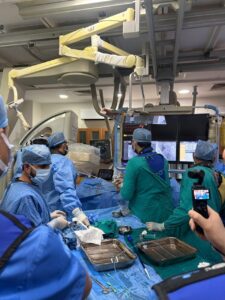
This successful case was possible because of a highly coordinated team involving interventional cardiology, cardiac surgery, anaesthesia, imaging, cath lab support, and device specialists.
I am grateful to the fantastic team at Mahatma Gandhi Medical College and Hospital, Jaipur, and the entire team involved in this milestone, including:
- Dr. Ajay Meena — CTVS
- Dr. Saurabh Gupta — Anaesthesia
- Dr. Ashish Jain — Anaesthesia
- Dr. Abhinav — Anaesthesia
- Dr. Rajiv — Cardiology
- Dr. Prashant Vaijyanath — CTVS
My gratitude also extends to the wider team and collaborators, including Gaurav Agarwal, Subramaniam R, Angsuman Hazra, Involution, and everyone who contributed to making this milestone possible.
The strength of a heart team lies in planning together, anticipating challenges together, and executing safely together.
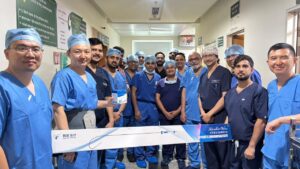
The multidisciplinary heart team after successfully performing India’s first dedicated TAVR/TAVI for pure Aortic Regurgitation.
Role of Imaging in Dedicated TAVR/TAVI for Pure AR
In pure Aortic Regurgitation, imaging plays a critical role before, during, and after the procedure.
Before the procedure, detailed imaging helps assess:
- Aortic valve anatomy
- Aortic annulus size
- Aortic root dimensions
- Valve leaflet structure
- Presence or absence of calcium
- Coronary artery height
- Severity of regurgitation
- Left ventricular size and function
During the procedure, imaging helps guide valve positioning and deployment. After the procedure, imaging confirms valve function and checks for any residual leak.
In such cases, precision is everything. The device selection, sizing, approach, and deployment strategy all depend on detailed planning.
TAVR/TAVI: A Less Invasive Option for Selected Patients
TAVR/TAVI has transformed the treatment of aortic valve disease. Instead of opening the chest, the valve is usually delivered through a catheter, commonly through the femoral artery in the groin.
The benefits of TAVR/TAVI in selected patients may include:
- Less invasive approach
- No large chest incision
- Faster recovery compared to open surgery in suitable patients
- Reduced physical stress for high-risk patients
- Shorter hospital stay in many cases
- Treatment option for patients who may not tolerate surgery well
For Aortic Stenosis, TAVR is already well established. For pure Aortic Regurgitation, dedicated devices may now help expand the possibilities in carefully selected patients.
A New Chapter in Structural Heart Interventions in India
This procedure represents a new chapter in structural heart interventions in India.
For years, pure Aortic Regurgitation has remained a difficult area for transcatheter valve therapy. Many conventional devices were designed primarily for calcific Aortic Stenosis. But with dedicated devices, we may now be able to treat more complex valve anatomies.
This is important because medicine must keep moving toward more personalized solutions. Not every valve disease is the same. Not every patient has the same anatomy. Not every patient can undergo the same treatment.
Dedicated technology allows us to match the treatment more closely to the patient’s condition.
That is why this milestone is meaningful.
My Personal Reflection
Being part of this case was truly special.
From the early phase of bench testing to the successful treatment of the first patient in India, the journey was filled with learning, planning, and teamwork.
The most satisfying part is knowing that this technology may help patients who otherwise could not be treated with conventional TAVR/TAVI devices.
As a structural heart specialist, moments like this remind me why innovation matters. Every advancement is valuable only when it can improve patient care.
I am thrilled that this dedicated TAVI device may create new hope for patients with pure Aortic Regurgitation, especially those with no aortic valve calcium who were previously difficult to treat.
FAQs
1. What is TAVR or TAVI?
TAVR stands for Transcatheter Aortic Valve Replacement. TAVI stands for Transcatheter Aortic Valve Implantation. Both terms refer to a minimally invasive procedure where a diseased aortic valve is replaced using a catheter-based technique instead of traditional open-heart surgery.
2. What is Aortic Regurgitation?
Aortic Regurgitation is a condition where the aortic valve does not close properly, allowing blood to leak backward into the heart. Over time, this can cause the heart to enlarge and weaken.
3. Why is pure Aortic Regurgitation difficult to treat with conventional TAVR?
Pure Aortic Regurgitation is difficult because the valve often has little or no calcium. Conventional TAVR devices usually need calcium or firm valve structure to anchor properly. Without that support, valve stability can become challenging.
4. What is special about a dedicated TAVI device for pure AR?
A dedicated TAVI device for pure Aortic Regurgitation is designed to work in patients with non-calcified valves. The device used in this milestone case has an anchoring mechanism that latches onto the native aortic valve leaflets.
5. Is TAVR suitable for all patients with Aortic Regurgitation?
No. TAVR is not suitable for every patient with Aortic Regurgitation. Each patient needs detailed evaluation by a heart team to assess valve anatomy, heart function, surgical risk, and suitability for the procedure.
6. Why is this procedure important in India?
This procedure is important because it marks India’s first dedicated TAVR/TAVI for pure Aortic Regurgitation. It may open new possibilities for selected patients who were not suitable for conventional TAVR/TAVI devices.
7. Who should evaluate patients for this procedure?
Patients with severe Aortic Regurgitation should be evaluated by a dedicated heart valve team, including interventional cardiologists, cardiac surgeons, imaging specialists, anaesthetists, and structural heart experts.