


 9 September, 2026
Successful MitraClip After Heart Transplant: A Complex TEER Case by Dr. A B Gopalamurugan
A 35-year-old heart transplant recipient with severe mitral valve leakage underwent a challenging two-clip repair, with encouraging improvement reported at follow-up.
According to Dr. A B Gopalamurugan, this represents India’s first MitraClip procedure performed after cardiac transplantation.
For a patient who had lived well for around two decades after a heart transplant, the return of heart failure symptoms presented a difficult new challenge. The transplanted heart had developed severe mitral regurgitation—a significant leak in one of its main valves—and daily activity had become severely limited.
The treatment options under consideration included addressing the valve leak, a left ventricular assist device (LVAD), or a repeat heart transplant. Following medical optimisation and multidisciplinary assessment, the HeartTeam chose transcatheter edge-to-edge repair (TEER) using MitraClip to reduce the leak and relieve symptoms.
Dr. A B Gopalamurugan’s account describes a technically demanding procedure requiring an approach adapted to the patient’s altered heart anatomy. Two clips were used, leaving mild residual mitral regurgitation. At the reported outpatient follow-up, the patient was doing well, with functional status improving from NYHA class III–IV to class I–II.
The patient’s journey: a heart transplant in 2002
The patient, described as 35 years old at presentation, had undergone a cardiac transplant in Berlin in 2002 and had done well for approximately 20 years.
He later developed transplant vasculopathy affecting the coronary arteries. In this case, coronary obstruction had required several percutaneous coronary interventions (PCIs). Dr. Gopalamurugan identified the mitral regurgitation as ischaemic in origin, meaning it was related to the effects of impaired blood supply on the heart and its valve-supporting structures.
By the time of referral, the patient had heart failure with severe mitral regurgitation and NYHA class III–IV symptoms. This classification describes marked restriction of activity, potentially extending to symptoms at rest at the more severe end of the range. It describes functional limitation rather than a percentage of heart function
The central question for the team was how best to reduce the patient’s symptoms while accounting for the transplanted heart, previous coronary treatments, and the complexity of further intervention.
What is mitral regurgitation?
The mitral valve sits between the left atrium and left ventricle. It normally helps blood move forward through the heart. When it does not close adequately, some blood flows backwards into the left atrium as the ventricle contracts. This is called mitral regurgitation, or MR.
Significant MR can contribute to breathlessness, fatigue, reduced exercise tolerance, and difficulty breathing when lying flat. Some patients experience palpitations or wake at night feeling short of breath. Symptoms and their severity vary between individuals.
In this patient, severe MR was an important treatment target within a wider, complex heart failure condition.
TEER and MitraClip: what is the difference?
TEER is the procedure; MitraClip is the device used to perform it.
Transcatheter edge-to-edge repair brings together portions of the mitral valve’s two leaflets to reduce the gap through which blood leaks backwards. MitraClip is delivered through a catheter introduced through a vein in the groin. The implant remains attached to the valve, while blood continues to flow through the remaining valve openings.
This catheter-based approach avoids an open-chest incision for the valve repair. Depending on the anatomy and the remaining leak, more than one clip may be needed.
TEER is a specialised intervention. A multidisciplinary team evaluates the valve anatomy, the cause of leakage, symptoms, response to medical therapy, and the suitability of other treatment options. Guidelines support TEER in selected patients; the presence of MR alone does not establish eligibility.
Why the HeartTeam chose TEER in this case
Before proceeding, the team optimised the patient’s left ventricular condition with medical management. Following assessment, the HeartTeam chose TEER as a palliative strategy.
Here, “palliative” describes an intervention intended to reduce the burden of valve leakage and improve symptoms in the context of complex underlying disease. The reported treatment decision should not be interpreted as a cure for transplant vasculopathy or as proof that the patient will never need an LVAD or another transplant.
The treating doctor’s account does not provide the patient’s ejection fraction, exact medication regimen, or a formal surgical-risk score. These details should not be inferred from the clips or added to the case narrative.
Why this procedure was particularly challenging
An unusually long distance to the mitral valve
Echocardiography showed elongated atria associated with the atrial anastomosis—the surgical joining of tissue during the earlier transplant.
Dr. Gopalamurugan reported that the distance from a conventional posterior transseptal puncture point to the mitral valve exceeded 7 cm. The transseptal puncture is the passage created through the wall separating the atria to access the left side of the heart.
In this anatomy, a conventional approach raised concern that the clip delivery system might not reach the valve adequately. The team therefore had to account carefully for the relationship between the entry point, available reach, and target valve.
This is a learning point from this particular case. It does not mean that every transplant recipient has the same anatomy or needs the same access strategy. The final puncture location was not specified in the supplied account.
Standard ultrasound views were difficult to obtain
The previous transplant had also changed the heart’s orientation. Traditional transoesophageal echocardiography angles and views did not provide the usual images needed for a standard TEER procedure.
The team had to use the available views to understand the valve and orient the clip. This illustrates why procedural imaging expertise and collaboration are especially important when anatomy differs from the usual pattern.
TEER generally combines echocardiography with fluoroscopic X-ray guidance to guide the catheter and repair device.
The two-clip repair
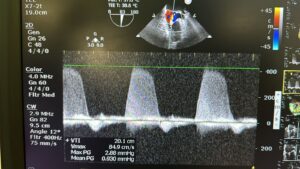
The first implant was an XTW MitraClip. According to the doctor, this reduced the mitral regurgitation, but a residual leak remained on the medial side of the valve.
At that stage, the mean gradient across the mitral valve was 2 mmHg. The team then placed a second XT clip medially to address the remaining leak.
This sequence demonstrates the importance of reassessment during the procedure: the team evaluated the residual leak and the pressure gradient before completing the repair.
The 2 mmHg measurement belongs specifically to the stage after the first clip. It should not be presented as the final measurement after both clips.
The reported result: mild MR and improved activity
After the second clip, the doctor reported mild residual mitral regurgitation. The patient was mobilising without symptoms and was doing well at the outpatient follow-up described in the message.
His reported NYHA class improved from III–IV before treatment to I–II at follow-up, indicating substantially less limitation during activity.
| Measure | Reported finding |
|---|---|
| Before TEER | Severe MR with heart failure; NYHA class III–IV |
| After the first XTW clip | MR reduced; residual medial leak remained |
| Mean mitral gradient after first clip | 2 mmHg |
| Second implant | XT clip placed medially |
| After both clips | Mild residual MR |
| Reported outpatient follow-up | Doing well; NYHA class I–II |
These are encouraging findings from the treating clinician’s account. The exact follow-up interval was not supplied, so this should be described as the reported follow-up outcome, rather than a proven long-term result.
What this case contributes
Dr. A B Gopalamurugan describes this as the first post-cardiac-transplant MitraClip case in India. The case highlights the need to adapt access planning and imaging to unusual post-transplant anatomy, and to reassess the result carefully after each implant.
It also demonstrates the contribution of coordinated decision-making. Dr. Gopalamurugan acknowledged the entire HeartTeam and Cardiac Transplant Team for their role in the patient’s care.
For patients and families, the case illustrates that a specialist team may identify a catheter-based treatment option even in a complex clinical situation. Whether such an approach is appropriate depends on the individual patient’s anatomy and overall condition.
Frequently asked questions
Can MitraClip be performed after a heart transplant?
This case shows that it can be performed in a carefully selected transplant recipient. The patient’s previous surgery and altered anatomy made the procedure particularly challenging. A transplant history alone does not determine suitability.
Does TEER replace the mitral valve?
No. It repairs the existing valve by joining portions of its leaflets. MitraClip is the implanted device used for this repair.
Why were two clips needed?
In this case, the first XTW clip reduced the leak, but a medial leak remained. A second XT clip was placed to address it. The number of clips is decided for the individual anatomy and procedural findings.
Is TEER suitable for everyone with mitral regurgitation?
No. Treatment can involve medicines, surgery, or catheter-based intervention depending on the cause and severity of MR and the patient’s clinical circumstances. A specialist HeartTeam assesses the options.
Are there risks?
Yes. Risks include bleeding, blood-vessel injury, infection, stroke, and other serious complications. The leak may not reduce sufficiently, and additional treatment may be needed. The treating team explains the individual balance of benefits and risks.
Does the patient still need follow-up?
Yes. Continued cardiology and transplant-team follow-up remains essential. The reported symptom improvement does not remove the need to monitor the valve repair and underlying heart condition. Regular follow-up is part of care after MitraClip.
Does this mean another transplant has been permanently avoided?
That conclusion cannot be drawn from the supplied information. TEER was chosen to palliate the MR, and the reported follow-up was encouraging. Decisions about future advanced heart failure treatment depend on the patient’s subsequent course.
Discussing treatment options
Patients with significant mitral valve leakage and persistent symptoms can seek a specialist assessment to understand their options. For an evaluation with Dr. A B Gopalamurugan, use the appointment details provided on his official clinic or hospital page.
This article provides general education and describes an individual case. Treatment decisions require a clinical assessment.
About Dr. A B Gopalamurugan
Dr. A B Gopalamurugan is an interventional cardiologist whose work includes advanced catheter-based treatments for structural heart disease. His clinical expertise includes transcatheter edge-to-edge repair (TEER) using MitraClip for carefully selected patients with mitral valve regurgitation.
In the case described above, he worked with the HeartTeam and Cardiac Transplant Team to treat severe mitral regurgitation in a heart transplant recipient. The procedure required personalised planning and specialised imaging guidance because of the patient’s complex post-transplant anatomy.
Consultation for Mitral Valve Regurgitation
If you have been diagnosed with significant mitral valve leakage, a specialist assessment can help determine whether medicines, surgery, or a catheter-based procedure such as TEER is appropriate.
MitraClip after heart transplant; TEER after cardiac transplant; post-transplant mitral valve repair, MitraClip procedure in India; transcatheter edge-to-edge repair; TEER for mitral regurgitation, Treatment for severe mitral valve leakage; mitral valve repair without open-heart surgery; MitraClip for high-risk patients, Dr A B Gopalamurugan MitraClip; Dr A B Gopalamurugan TEER; Dr A B Gopalamurugan cardiologist, MitraClip specialist in India; TEER procedure in India; mitral valve repair in India