


 16 June, 2026
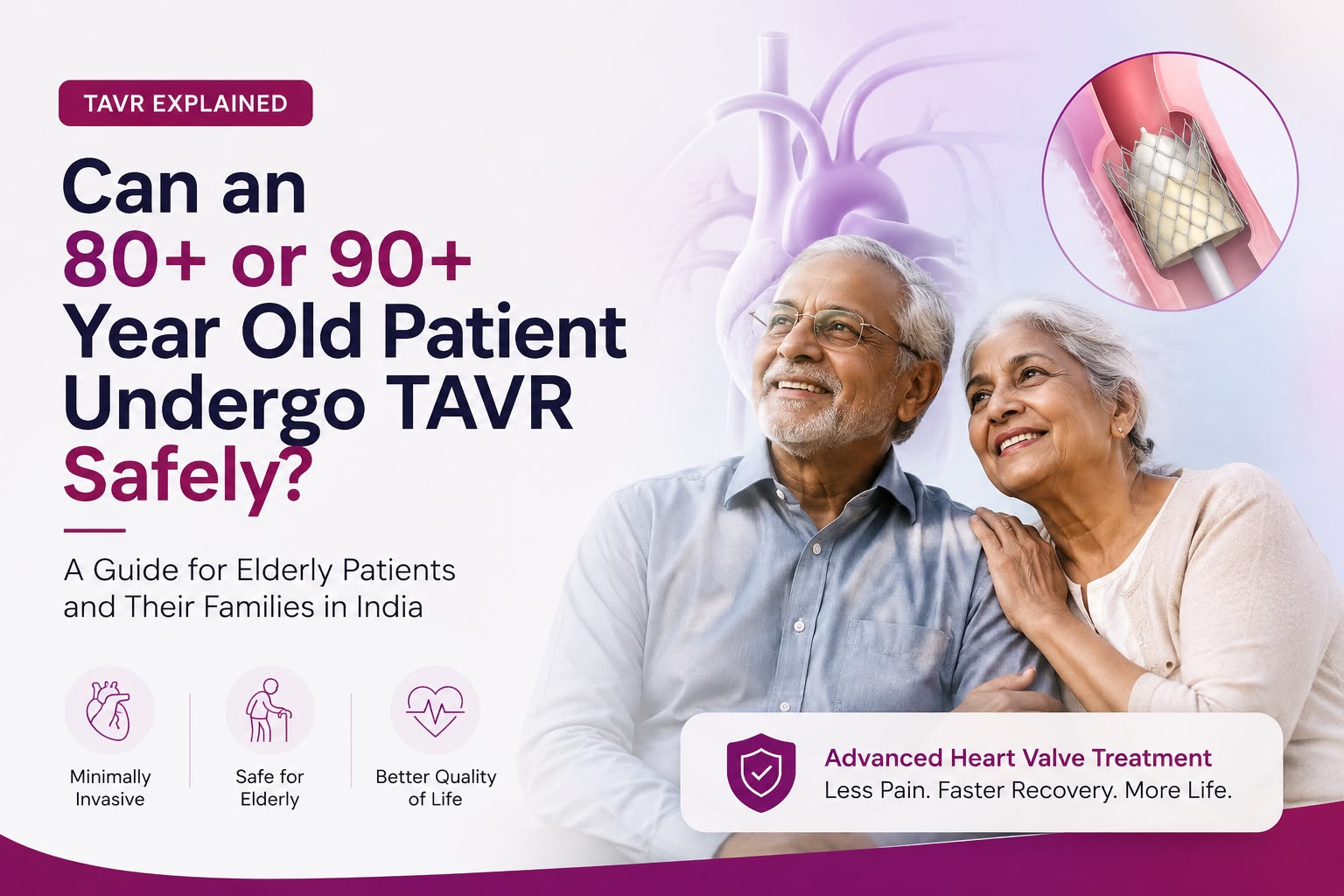
Can an 80+ or 90+ Year Old Patient Undergo TAVR Safely?
For many Indian families, the moment they hear that an elderly parent or grandparent has a “severe heart valve narrowing,” the first worry is usually this:
“At this age, can they safely undergo treatment?”
This question becomes even more emotional when the patient is 80, 85, 90, or older. Traditionally, many elderly patients with severe aortic stenosis were considered too high-risk for open-heart surgery. But today, TAVR / TAVI has changed the way doctors treat severe aortic valve disease in elderly and high-risk patients.
TAVR, also called TAVI in many parts of India, stands for Transcatheter Aortic Valve Replacement / Implantation. It is a minimally invasive heart valve procedure used to replace a severely narrowed aortic valve without opening the chest in the way conventional surgery requires. Medical centres worldwide describe TAVR as a treatment for a narrowed aortic valve, also known as aortic stenosis.
For elderly patients in India, especially those above 80 or 90, the real answer is:
Yes, many 80+ and even selected 90+ year-old patients can undergo TAVR safely — but only after careful evaluation by an experienced heart team.
What is severe aortic stenosis?
The aortic valve is one of the main valves of the heart. It allows blood to flow from the heart to the rest of the body. With age, calcium can build up on this valve, making it stiff and narrow. This condition is called aortic stenosis.
When the narrowing becomes severe, the heart has to work harder to pump blood. In elderly patients, symptoms may include:
Breathlessness while walking or lying down
Chest heaviness or chest pain
Dizziness or fainting
Fatigue and reduced activity
Swelling in the legs
Repeated hospital admissions for heart failure
In India, many families mistake these symptoms for “normal old age.” But severe aortic stenosis is not simply aging. It is a serious heart valve condition that can worsen over time and may require valve replacement.
Why open-heart surgery may be difficult in elderly patients
For a younger and fit patient, surgical aortic valve replacement may be suitable. But for many elderly Indian patients, especially those above 80 or 90, open-heart surgery may carry higher risk because of age-related health issues such as:
Diabetes, kidney disease, lung disease, previous bypass surgery, weak heart pumping function, frailty, history of stroke, calcified arteries, anemia, or general weakness.
This is where TAVR in India has become an important option. Instead of opening the chest, the new valve is usually taken through a blood vessel in the groin and placed inside the diseased valve.
Why TAVR is often considered for patients above 80
International valve guidelines support TAVR as an important treatment option in elderly patients. The American College of Cardiology notes that TAVI is favored in older patients over 80 years of age, especially when life expectancy and surgical risk make a catheter-based valve replacement more suitable.
European guidance also places strong importance on age, surgical risk, anatomy, and discussion by a heart team when choosing between TAVI and surgery. In many elderly patients, especially those aged 75 and above or those at high surgical risk, TAVI is commonly recommended as a preferred option.
This does not mean every 80+ patient automatically needs TAVR. It means that age alone should not deny treatment, and the decision should be based on the patient’s overall condition, valve anatomy, CT scan, heart function, kidney function, mobility, and expected quality of life.
Can a 90-year-old undergo TAVR?
Yes, selected 90+ patients can undergo TAVR. In medical language, patients above 90 are called nonagenarians. Several studies have looked at TAVR outcomes in nonagenarians and found that carefully selected patients can benefit from the procedure.
A review of TAVR in patients over 90 reported that nonagenarians can experience meaningful improvement in quality of life after TAVR, with heart failure readmission rates similar to younger elderly patients in some cohorts.
Another analysis comparing TAVR and surgical valve replacement in nonagenarians found that TAVR was associated with fewer perioperative complications, shorter hospital stay, and a higher chance of discharge home compared with surgery in this very elderly group.
So, the question is not simply:
“Is the patient 90?”
The better question is:
“Is the patient 90 but still likely to benefit from valve replacement with acceptable risk?”
Who may be a good candidate for TAVR after 80 or 90?
An elderly patient may be considered for TAVR if they have:
Severe symptomatic aortic stenosis
Breathlessness, fainting, chest pain, or heart failure due to valve narrowing
High risk for open-heart surgery
Suitable valve anatomy on CT scan
Acceptable blood vessel access for the TAVR valve
Reasonable chance of improvement in daily life after the procedure
For example, if an 85-year-old patient is unable to walk because of breathlessness caused mainly by severe aortic stenosis, TAVR may help restore comfort and mobility.
Similarly, if a 90-year-old patient is mentally alert, has family support, and has symptoms mainly due to aortic valve narrowing, TAVR may be considered after detailed assessment.
Who may not be suitable for TAVR?
TAVR is advanced and minimally invasive, but it is not suitable for every patient. Some patients may not benefit if they have:
Very limited life expectancy from another advanced illness, severe frailty where recovery is unlikely, active infection, unsuitable valve anatomy, very poor blood vessel access, severe multi-organ failure, or symptoms not mainly caused by aortic stenosis.
This is why proper evaluation is essential. The goal is not just to perform a procedure. The goal is to choose the treatment that gives the patient the best possible outcome.
What tests are needed before TAVR?
Before TAVR, the patient usually undergoes a detailed heart valve workup. This may include:
Echocardiogram: To confirm the severity of aortic stenosis and assess heart pumping function.
CT TAVR planning scan: To measure the valve, aorta, calcium, and blood vessels.
Coronary angiogram: To check for artery blockages.
Blood tests: To assess kidney function, blood count, infection markers, and other risks.
Frailty and functional assessment: To understand how well the patient may recover.
Heart team discussion: To decide whether TAVR, surgery, balloon valvuloplasty, or medical management is most appropriate.
For elderly patients, planning is extremely important. The success of TAVR depends not only on the valve but also on careful imaging, correct valve sizing, safe access, and experienced procedural execution.
Is TAVR painful?
Most patients do not experience major pain because TAVR is done through small access points, commonly through the groin. Depending on the patient’s condition and centre protocol, it may be done under general anesthesia or conscious sedation.
Compared to open-heart surgery, there is no large chest incision and usually no need to cut the breastbone. This is one reason elderly patients often recover faster after TAVR than after conventional surgery.
How long is the hospital stay after TAVR?
Hospital stay varies from patient to patient. Many elderly patients are monitored for a few days after the procedure, especially to check heart rhythm, kidney function, blood pressure, walking ability, and valve performance.
Some patients may recover quickly, while others may need longer observation if they have kidney disease, lung disease, low heart function, rhythm issues, or general frailty.
What are the risks of TAVR in elderly patients?
TAVR is less invasive than surgery, but it is still a major heart procedure. Possible risks include:
Bleeding from the groin access site, blood vessel injury, stroke, kidney problems, valve leakage, heart rhythm disturbance, need for pacemaker, infection, or rarely death.
The chance of these risks depends on the patient’s age, anatomy, calcium burden, kidney function, heart function, vascular access, and other medical conditions.
This is why elderly patients should undergo TAVR only at centres with strong experience in structural heart interventions and transcatheter valve therapies.
Why TAVR is especially relevant for Indian elderly patients
India has a rapidly growing elderly population. Many patients above 75 or 80 now live active lives and want treatment that improves comfort, independence, and dignity. At the same time, many elderly Indian patients also have diabetes, hypertension, kidney disease, previous angioplasty, previous bypass surgery, or lung disease.
For such patients, TAVR / TAVI in India offers an important option when open-heart surgery is considered risky.
Families often ask:
“Will my father be able to walk better after TAVR?”
“Will my mother’s breathlessness reduce?”
“Can my grandfather tolerate the procedure?”
“Is TAVR safe after 90?”
The answer depends on proper patient selection. In the right patient, TAVR can reduce symptoms, improve daily activity, and reduce repeated heart failure admissions.
TAVR vs surgery in elderly patients
The choice between TAVR and surgery depends on multiple factors.
TAVR may be preferred when:
The patient is above 80, high-risk for surgery, frail, has previous bypass surgery, has lung disease, or needs faster recovery.
Surgery may be preferred when:
The patient is younger, has longer life expectancy, unsuitable TAVR anatomy, associated valve disease requiring surgery, or other cardiac conditions that need surgical correction.
For patients between 65 and 80, both options may be discussed depending on anatomy, risk, and long-term planning. For patients above 80, TAVR is often strongly considered if anatomy is suitable and the expected benefit is meaningful.
Common myths about TAVR in 80+ and 90+ patients
Myth 1: “At this age, nothing can be done.”
This is not true. Many elderly patients with severe aortic stenosis may still be treatable. Age is important, but it is not the only factor.
Myth 2: “TAVR is only for foreign countries.”
TAVR is now available in India at advanced cardiac centres, including major cities like Chennai, Mumbai, Bangalore, Hyderabad, Delhi, and other metro regions.
Myth 3: “Breathlessness is normal after 80.”
Breathlessness may be due to lung disease, anemia, weakness, or heart failure. But in many elderly patients, severe aortic stenosis is an important and treatable cause.
Myth 4: “If surgery is risky, no treatment is possible.”
TAVR was developed especially to help patients who may not be ideal candidates for open-heart surgery.
When should families consult a TAVR specialist?
Families should seek evaluation if an elderly patient has been diagnosed with severe aortic stenosis or has symptoms such as:
Breathlessness on walking, repeated hospitalization for heart failure, chest heaviness, fainting, dizziness, extreme fatigue, or reduced ability to perform daily activities.
A consultation with a TAVR specialist in Chennai / India can help determine whether the patient needs urgent treatment, continued monitoring, or another form of care.
Why experience matters in TAVR
TAVR is not just a procedure. It is a complete heart valve programme involving advanced imaging, clinical judgment, catheter-based skills, valve selection, complication management, and post-procedure follow-up.
Dr. A.B. Gopalamurugan is a Senior Interventional Cardiologist and Electrophysiologist with extensive experience in complex cardiac interventions, electrophysiology, device therapy, and transcatheter valve therapies. His international training and experience in advanced interventional cardiology support a comprehensive approach to elderly patients with complex valve disease.
For elderly Indian patients, especially those above 80 or 90, the most important step is a detailed, honest, and individualized assessment.
Conclusion
An 80+ or 90+ year-old patient can undergo TAVR safely in selected cases. The decision should not be based on age alone. It should be based on symptoms, severity of aortic stenosis, frailty, CT anatomy, heart function, kidney function, surgical risk, and the patient’s expected quality of life after treatment.
For many elderly patients in India, TAVR offers hope when open-heart surgery may be too risky.
If your parent or grandparent has been diagnosed with severe aortic stenosis, do not assume that age means there are no options. A proper TAVR evaluation can help the family make the right decision.
FAQs
Is TAVR safe for patients above 80?
Yes, many patients above 80 can safely undergo TAVR if they are properly selected. The decision depends on valve severity, symptoms, CT scan findings, frailty, kidney function, heart function, and overall health.
Can a 90-year-old undergo TAVR?
Yes, selected 90+ patients can undergo TAVR. Age alone is not the deciding factor. The key question is whether the patient is likely to benefit from the procedure with acceptable risk.
Is TAVR better than open-heart surgery for elderly patients?
For many elderly or high-risk patients, TAVR may be preferred because it is less invasive and usually allows faster recovery. However, the final decision should be made after a heart team evaluation.
How is TAVR done?
TAVR is usually performed through a small puncture in the groin. A new valve is delivered through a catheter and placed inside the narrowed aortic valve.
How long does recovery take after TAVR?
Recovery varies. Many patients begin walking soon after the procedure and may leave the hospital within a few days, depending on their condition and medical risks.
Is TAVR available in India?
Yes, TAVR/TAVI is available in India at advanced cardiac centres. Patients should choose a centre and specialist with experience in structural heart and transcatheter valve procedures.
Who should consider TAVR?
Patients with severe symptomatic aortic stenosis, especially elderly patients or those at high risk for open-heart surgery, should consult a TAVR specialist for evaluation.
Can TAVR improve breathlessness in elderly patients?
If breathlessness is mainly due to severe aortic stenosis, TAVR can often improve symptoms and daily activity. Proper diagnosis is important before deciding treatment.
Is TAVR a permanent cure?
TAVR replaces the narrowed valve with a new artificial valve. Regular follow-up is needed to monitor valve function, heart rhythm, medications, and long-term heart health.
What is the difference between TAVR and TAVI?
TAVR and TAVI usually refer to the same procedure. TAVR means Transcatheter Aortic Valve Replacement, while TAVI means Transcatheter Aortic Valve Implantation. Both terms are commonly used in India.
TAVR in India | TAVI in India | TAVR in Chennai | TAVI Chennai | TAVR for elderly patients | TAVR for 80 year old | TAVR for 90 year old | Aortic stenosis treatment in India | Heart valve replacement without open heart surgery | TAVR specialist in Chennai | Transcatheter aortic valve replacement India | TAVI for elderly patients India