


 21 May, 2026
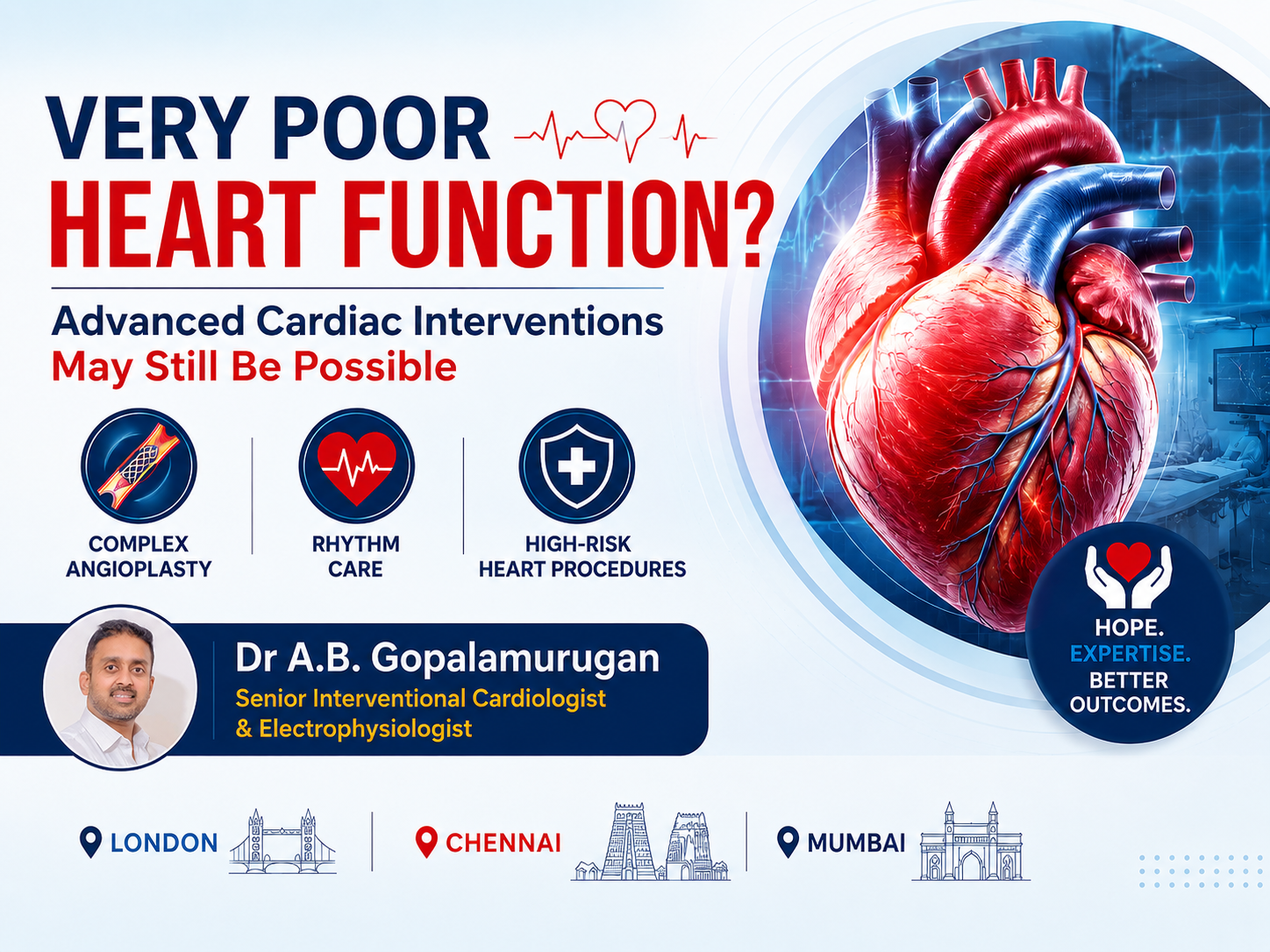
When the Heart Is Weak, Treatment Needs Strength: Advanced Interventions for Patients with Very Poor Heart Function
For many patients, the words “your heart function is very poor” feel frightening.
They may think treatment options are limited. Some are told they are “high-risk.” Some are afraid of angioplasty, pacemakers, rhythm procedures, or any heart intervention because they believe their heart may not tolerate it.
But modern cardiology has changed the way we look at weak hearts.
A weak heart does not always mean nothing can be done.
It means everything must be planned more carefully.
This is where advanced interventional cardiology and electrophysiology become important — especially for patients with very poor heart pumping function, complex artery blockages, valve-related stress, or dangerous rhythm disturbances.
What Does “Very Poor Heart Function” Actually Mean?
The heart works like a pump. With every beat, it pushes blood to the brain, kidneys, lungs, and the rest of the body.
Doctors often measure heart pumping strength using ejection fraction, or EF. EF shows how much blood the left ventricle pumps out with each heartbeat.
But EF is not just a number.
A low EF can explain why a patient may feel:
- Breathless while walking
- Tired even after small activity
- Swelling in the legs
- Chest heaviness
- Palpitations
- Dizziness or fainting
- Difficulty sleeping flat
- Repeated hospital admissions for fluid overload
In simple words, the body is asking for more blood flow, but the heart is struggling to deliver it.
Why Interventions Become More Challenging in Weak Hearts
In a patient with normal heart function, the heart has reserve power. It can tolerate stress better during a procedure.
But in a patient with very poor heart function, even a small drop in blood pressure, rhythm disturbance, or temporary reduction in blood flow can become serious.
That is why these cases need a different mindset.
Not just:
“Can we open the blockage?”
But:
“Can we open the blockage safely, protect the heart during the procedure, control the rhythm, support circulation, and improve long-term outcomes?”
This is the difference between a routine heart procedure and a carefully planned high-risk cardiac intervention.
Can Patients with Very Poor Heart Function Undergo Cardiac Interventions?
In selected patients, yes.
Heart failure treatment is often a combination of lifestyle changes, medicines, rhythm-control devices, angioplasty or bypass, valve procedures, and in advanced cases, mechanical support or transplant evaluation.
The key is patient selection.
Every patient with poor heart function is different. One patient may have a blocked artery that can be opened. Another may have an electrical rhythm problem that needs correction. Another may need valve treatment. Another may need advanced heart failure medicines first before any procedure is considered.
So the real question is not, “Is the heart weak?”
The real question is, “Why is the heart weak — and what can be corrected?”
The 5 Main Situations Where Advanced Interventions May Help
1. Severe Artery Blockages with Weak Heart Function
Sometimes the heart is weak because its own blood supply is reduced.
If major heart arteries are severely narrowed or blocked, the heart muscle may become tired, under-supplied, or “hibernating.” In selected patients, improving blood flow through angioplasty, stenting, complex PCI, CTO intervention, or bypass surgery may help reduce symptoms and improve quality of life.
But these are not routine cases.
Patients with poor EF and multiple blockages may need:
- Detailed coronary angiogram review
- Echocardiography
- Viability assessment in selected cases
- Kidney function evaluation
- Blood thinner planning
- Heart team discussion
- Mechanical circulatory support planning in very high-risk cases
The aim is not just to open an artery.
The aim is to open the right artery, at the right time, with the right safety strategy.
2. High-Risk Angioplasty in Low EF Patients
High-risk angioplasty may be considered when a patient has:
- Very low EF
- Left main artery disease
- Multiple complex blockages
- Previous bypass surgery
- Severe calcification
- Chronic total occlusion
- Kidney disease
- Advanced age
- Breathlessness or heart failure symptoms
- Not suitable for open-heart surgery
In such patients, the procedure may require advanced tools such as intravascular imaging, calcium modification techniques, careful contrast control, and sometimes temporary heart support devices.
Mechanical circulatory support is not used for every case, but in selected high-risk patients it may help support circulation during complex procedures.
This is why experience matters.
In weak-heart interventions, the doctor must know not only how to start the procedure — but also how to anticipate what can go wrong and how to protect the patient before it happens.
3. Rhythm Problems That Make Heart Function Worse
A weak heart can cause rhythm problems.
But rhythm problems can also make the heart weak.
This is where electrophysiology becomes extremely important.
Patients with poor heart function may develop:
- Atrial fibrillation
- Ventricular tachycardia
- Frequent premature beats
- Slow heart rhythm
- Bundle branch block
- Sudden cardiac arrest risk
Some rhythm problems reduce the heart’s efficiency. Others increase the risk of sudden collapse.
Depending on the cause, treatment may include medicines, ablation, pacemaker therapy, ICD implantation, or CRT device therapy.
For patients, this is important to understand:
A device is not always “just a pacemaker.”
Sometimes it is a life-protecting system.
Sometimes it helps the heart beat more efficiently.
Sometimes it prevents a dangerous rhythm from becoming fatal.
4. Valve Disease with Poor Heart Function
Sometimes the heart becomes weak because a valve is too tight or too leaky.
For example:
- A tight aortic valve can force the heart to pump against high pressure.
- A leaking mitral valve can cause blood to flow backward.
- Long-standing valve disease can enlarge and weaken the heart.
In selected patients, valve interventions may reduce the load on the heart. These may include surgical valve repair or replacement, transcatheter valve therapies, or other structural heart procedures depending on the patient’s anatomy and risk profile.
The important point is this:
When valve disease and poor heart function exist together, the decision should not be delayed until the heart becomes too weak to recover.
Early evaluation can make a major difference.
5. Patients Who Are Told They Are “Too High-Risk”
Many patients with very poor heart function hear one sentence repeatedly:
“Your case is risky.”
That may be true. But “risky” does not always mean “impossible.”
It means the patient needs a more detailed evaluation.
A high-risk patient may still be considered for intervention if the potential benefit is meaningful and the risk can be managed with planning.
This may involve:
- Stabilising heart failure first
- Optimising medicines
- Correcting rhythm problems
- Treating anemia or kidney issues
- Planning ICU backup
- Using imaging guidance
- Staging the procedure instead of doing everything at once
- Considering heart support during the procedure
- Discussing all options clearly with the patient and family
The goal is not aggressive treatment.
The goal is intelligent treatment.
Why These Cases Need a Specialist Approach
Interventions in very poor heart function require two skills at the same time:
Interventional cardiology — to treat blocked arteries, structural problems, and complex coronary disease.
Electrophysiology — to understand and treat rhythm problems that may worsen heart failure or increase sudden cardiac risk.
This combination is especially valuable because many weak-heart patients do not have only one issue.
They may have blockages plus atrial fibrillation.
Or low EF plus ventricular rhythm risk.
Or heart failure plus conduction delay.
Or previous angioplasty plus recurrent breathlessness.
A comprehensive approach looks at the heart as one connected system — pump, pipes, valves, and electricity.
Red Flags Patients Should Never Ignore
A patient with poor heart function should seek urgent medical attention if they experience:
- Chest pain or pressure
- Severe breathlessness at rest
- Fainting or near-fainting
- Sudden palpitations with dizziness
- Blue lips or severe weakness
- Rapid swelling of legs or abdomen
- Inability to lie flat due to breathlessness
- Sudden confusion or extreme fatigue
These may be signs that the heart is under serious stress.
The Patient Conversation That Matters Most
A good consultation for poor heart function should not feel rushed.
The patient and family should understand:
- What is the heart’s pumping strength?
- Why is the heart weak?
- Are there blocked arteries?
- Is there a rhythm problem?
- Is there valve disease?
- Are medicines optimised?
- Is an intervention needed now or later?
- What are the risks?
- What are the benefits?
- What happens if we do nothing?
- What support is available during and after the procedure?
This kind of discussion gives patients clarity — and clarity reduces fear.
Treatment Is Not Just About Survival. It Is About Living Better.
For many patients, the goal is not only to live longer.
It is to walk without stopping.
To sleep without breathlessness.
To reduce hospital admissions.
To feel less afraid of every heartbeat.
To return to daily life with more confidence.
Modern heart care is not about one heroic procedure.
It is about building a complete plan — medicines, procedures, rhythm care, lifestyle, follow-up, and long-term monitoring.
A weak heart needs more than treatment.
It needs a strategy.
About Dr A.B. Gopalamurugan
Dr A.B. Gopalamurugan
Senior Interventional Cardiologist & Electrophysiologist
Special focus:
Interventions in patients with very poor heart function, complex coronary artery disease, rhythm disorders, and high-risk cardiac conditions.
Consultation Locations
London
W1 Healthcare
7 Russell Gardens,
London W14 8EZ,
United Kingdom
Phone: +44 7425 861747
Chennai
2nd Floor, 46 & 48, Masilamani Rd,
Balaji Nagar, Royapettah,
Chennai, Tamil Nadu 600014
Phone: 080560 88898
Mumbai
81-84, Indian Cancer Society,
Formerly Lady Ratan Tata Medical & Research Centre,
M. Karve Road, Cooperage St,
Mumbai, Maharashtra 400021
Phone: 089400 88898
FAQs
1. Can angioplasty be done if heart function is very low?
In selected patients, angioplasty can be considered even when heart function is low. However, it requires careful planning, risk assessment, imaging, and sometimes advanced support during the procedure.
2. What is considered poor heart function?
Heart pumping function is commonly measured by ejection fraction. A low ejection fraction can suggest that the heart is not pumping strongly enough. However, symptoms, valve function, rhythm, artery blockages, and overall health also matter.
3. Why are weak-heart patients considered high-risk?
Because the heart may not tolerate sudden drops in blood pressure, rhythm changes, long procedures, kidney stress, or temporary changes in blood flow. That is why these cases need advanced planning.
4. Can rhythm problems make heart function worse?
Yes. Rhythm problems such as atrial fibrillation, frequent abnormal beats, slow rhythm, or ventricular arrhythmias can worsen heart function in some patients. Electrophysiology evaluation helps identify whether rhythm treatment is needed.
5. What treatments are available for patients with poor heart function?
Treatment may include medicines, lifestyle changes, angioplasty, bypass surgery, valve treatment, pacemakers, CRT, ICDs, rhythm procedures, mechanical support, or advanced heart failure care depending on the cause.
6. Is a weak heart always permanent?
Not always. Some patients improve when the underlying cause is treated — such as blocked arteries, rhythm problems, uncontrolled blood pressure, valve disease, or medication gaps. The possibility of improvement depends on the individual case.