


 2 October, 2026
TMVR vs MitraClip in India: Repair or Replace the Mitral Valve?
If you or a loved one has been told the mitral valve is leaking badly, you may hear two options: repair it with MitraClip (TEER), or replace it with TMVR. Both avoid open-heart surgery. But they work very differently, and choosing the right one can shape the rest of the patient’s life.
This guide explains TMVR vs MitraClip in simple language: how each works, who each suits, and how an experienced Heart Team decides. It is written from the experience of Dr A B Gopalamurugan, Senior Consultant Interventional Cardiologist in Chennai and a recognised pioneer of transcatheter mitral, tricuspid and aortic valve therapies (TAVR/TAVI) in India.
Why the Mitral Valve Matters
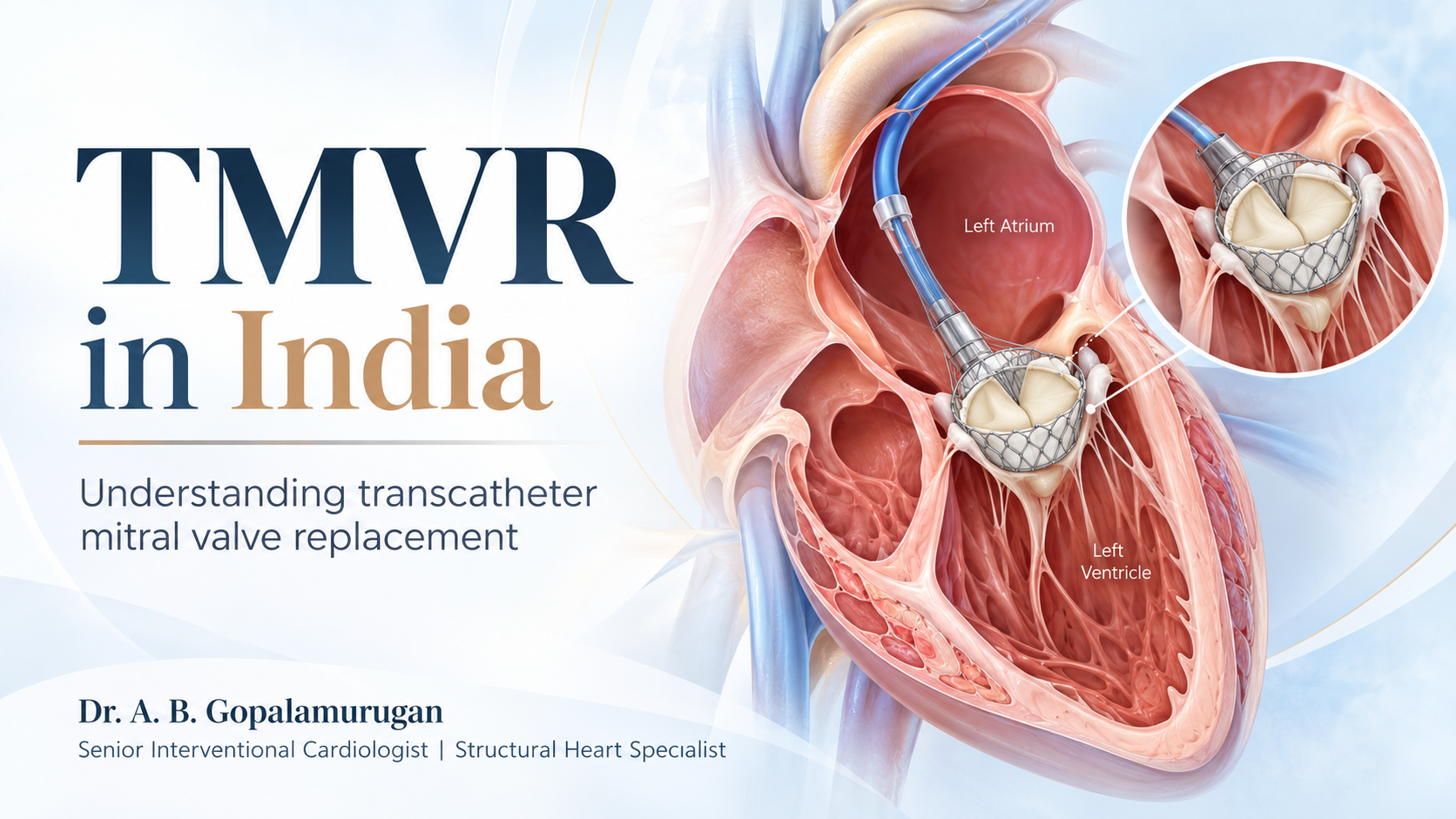
The mitral valve sits between the left atrium and the left ventricle. When it does not close properly, blood leaks backwards with every heartbeat. This is called mitral regurgitation (MR). Over time, severe MR can cause:
- Breathlessness, especially on walking or lying flat
- Tiredness and swelling of the legs
- Irregular heartbeat (atrial fibrillation)
- Repeated hospital admissions for heart failure
For many elderly or high-risk patients, open-heart surgery is too risky. That is where transcatheter mitral therapies such as MitraClip and TMVR come in.
MitraClip (TEER): Repairing the Patient’s Own Valve
MitraClip is a form of Transcatheter Edge-to-Edge Repair (TEER). A small clip is guided through a vein in the groin, across the wall between the heart’s upper chambers, and onto the mitral valve. The clip holds the two leaflets together at the point of the leak, reducing the backflow of blood.
Key features of MitraClip
- Keeps the native valve – nothing is removed or replaced
- Beating-heart procedure – guided live by 3D TEE imaging
- Quick recovery – many patients walk the next day
- Well studied – used worldwide in both degenerative (primary) MR and functional (secondary) MR in carefully selected patients
Learn more on our dedicated page: MitraClip & TEER in India.
TMVR: Replacing the Mitral Valve Without Open-Heart Surgery
Transcatheter Mitral Valve Replacement (TMVR) places a new valve inside the diseased mitral valve using a catheter. Instead of fixing the leak, it replaces the valve’s function entirely.
When TMVR is commonly used
- Mitral valve-in-valve – a previously implanted surgical tissue valve has worn out
- Mitral valve-in-ring – a surgical repair with an annuloplasty ring has failed
- Heavily calcified valves – selected patients with mitral annular calcification, where clip repair is unlikely to work
- Native valve TMVR – dedicated new-generation devices are emerging for selected patients
Read more: TMVR in India and our TMVR treatment page.
TMVR vs MitraClip: Side-by-Side Comparison
| Factor | MitraClip (TEER) | TMVR |
|---|---|---|
| What it does | Repairs the valve by clipping leaflets together | Replaces valve function with a new valve |
| Native valve | Preserved | Covered by the new valve |
| Best suited for | Suitable leaflet anatomy, degenerative or functional MR | Failed surgical valves/rings, calcified valves, anatomy unsuitable for repair |
| How much leak is removed | Significantly reduced; some residual MR possible | Usually eliminates the leak more completely |
| Main planning concern | Leaflet length, gap, valve area after clipping | Risk of LVOT obstruction, valve sizing on CT |
| Blood thinners | Usually antiplatelets or patient’s existing medicines | Often anticoagulation for a period after implant |
| Key imaging | 3D transoesophageal echo (TEE) | Cardiac CT plus TEE |
Repair or Replace? How the Heart Team Decides
There is no one-size-fits-all answer. At HeartTeam India, led by Dr Gopalamurugan, every patient is reviewed by a multidisciplinary team. The decision is based on:
- Cause of the leak – Is the valve itself damaged (primary MR), or is the heart enlarged and pulling the valve apart (secondary MR)?
- Valve anatomy – Leaflet length, calcium, clefts and the size of the gap between leaflets.
- Previous surgery – A failed tissue valve or ring often points towards valve-in-valve or valve-in-ring TMVR.
- CT planning – For TMVR, CT predicts whether the new valve could block the outflow of blood from the heart (neo-LVOT).
- Overall health – Age, kidney function, lung disease, frailty and patient wishes.
- Lifetime management – What options will remain if the patient needs another procedure in future?
Patient selection is the single most important step. Read our detailed article: Mitral TEER and MitraClip – Patient Selection Is Everything.
Why Experience Matters: Dr A B Gopalamurugan, India’s Pioneer in Transcatheter Valve Therapy
Transcatheter mitral procedures are among the most complex in cardiology. Experience with every valve – aortic, mitral, tricuspid and pulmonary – allows the team to choose the right tool rather than forcing one device onto every patient.
Dr A B Gopalamurugan is widely regarded as a pioneer of transcatheter valve therapy in India. His landmark contributions include:
- India’s first transcatheter mitral valve implantation (2017) – a mitral valve-in-valve procedure, published in the Indian Heart Journal
- India’s first transcatheter tricuspid valve implantation (2016), published in the Indian Heart Journal
- The first TAVI/TAVR in South India (2015)
- India’s first MitraClip after heart transplantation – read the case
- Three of the world’s first transcatheter valve procedures, and the introduction of more transcatheter valve therapies to India than any other operator
- Founder and Course Director of India Valves, the country’s largest course on transcatheter valve therapies
- More than 16 years of training and consultant practice in London, UK, with MD (University of London), MRCP and FRCP
This breadth means patients are offered MitraClip, TMVR, valve-in-valve, TAVR/TAVI or surgery based on what is right for them, not on what one centre happens to offer.
What to Expect: The Patient Journey
- Consultation – symptoms, history and medicines are reviewed.
- Imaging – transthoracic echo, transoesophageal echo (TEE) and, for TMVR, cardiac CT.
- Heart Team meeting – cardiologists, surgeons, imaging specialists and anaesthetists agree on the plan.
- Procedure – performed through the groin vein under anaesthesia with live imaging.
- Recovery – most patients are mobile within a day or two and go home within a few days.
- Follow-up – regular echo checks and optimisation of heart-failure medicines.
Frequently Asked Questions: TMVR vs MitraClip
Is TMVR better than MitraClip?
Neither is better for everyone. MitraClip (TEER) repairs the patient’s own valve and suits many patients with suitable leaflet anatomy. TMVR replaces the valve and is considered when repair is unlikely to work, such as a failed surgical valve or ring, or heavy calcification. The right choice depends on anatomy, imaging and overall health.
Is MitraClip done without open-heart surgery?
Yes. MitraClip is delivered through a vein in the groin, guided by 3D transoesophageal echocardiography (TEE) and X-ray. There is no chest incision and the heart is not stopped.
Who performed India’s first transcatheter mitral valve implantation?
Dr A B Gopalamurugan planned and performed India’s first transcatheter mitral valve implantation in 2017 (a mitral valve-in-valve procedure), published in the Indian Heart Journal.
How long is the hospital stay after MitraClip or TMVR?
Many patients are walking within a day and go home within a few days. The exact stay depends on the patient’s condition, the access route and recovery.
Can MitraClip be done after TMVR, or TMVR after MitraClip?
A clip can make later valve replacement more complex, and options after TMVR are different again. This is why lifetime planning by an experienced Heart Team matters before the first procedure.
Talk to an Expert About MitraClip or TMVR in India
If you have severe mitral regurgitation, a failing mitral bioprosthesis, or have been told you are “too high risk” for surgery, a specialist Heart Team review can open new options.
Book a consultation with Dr A B Gopalamurugan in Chennai:
📞 OP appointments: +91 91760 88898
✉️ secretary@gopalamurugan.com
📍 2nd Floor, 46 & 48, Masilamani Rd, Balaji Nagar, Royapettah, Chennai 600014
Contact us online
This article is for patient education only and is not a substitute for individual medical advice. Treatment decisions should be made with your cardiologist and Heart Team.